



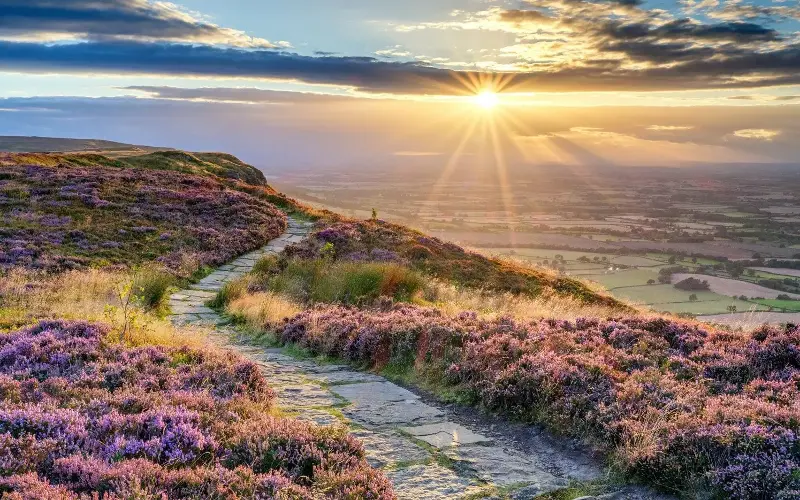
A quilt of lime-green and sunny-yellow fields, a speckled pattern of bales of golden hay, fringes of bottle-green trees, a deep-violet-coloured road curving across the scene. “I feel as though I’m walking through a David Hockney painting,” I said to my friend as we gazed down at the view.
Ridiculous – we were on a solid piece of ground – but also strangely true. Hockney, who died earlier this month aged 88, painted the Yorkshire Wolds over many years but especially in the early 2000s, catching them in ways and colours that were revelatory. Two years ago, as we were walking the 79-mile Yorkshire Wolds Way, from Hessle, near Hull, to Filey, I could see these were absolutely true to life.
Born in Bradford in 1937, Hockney may have spent more years in California than his native Yorkshire – but he remained a Yorkshireman to his core. No mid-Atlantic nonsense in that direct, slow-moving, half-amused accent. And he turned down the honour of being buried in Westminster Abbey – amongst other creative geniuses such as Charles Dickens, George Frederic Handel, Laurence Olivier and Stephen Hawking – in favour of the solid earth of Yorkshire.
And why not? Hockney developed his skills walking the streets of Bradford and sketching what he saw before studying at Bradford School of Art and then gaining a place at London’s Royal College of Art. If you want to see one of the largest (some say the largest) permanent public collections of Hockney’s work, then go to Salts Mill, in Saltaire, on Bradford’s outskirts.
Once you’ve seen the vivacity of Hockney’s Yorkshire paintings – Garrowby Hill, for example, a swirl of road and patchwork of fields based on views near Fridaythorpe in the East Riding, close to the Yorkshire Wolds Way – you start to see, and enjoy, the exuberance of the region’s landscapes.
Take the North York Moors, England’s largest expanse of heather moorland and, in August, a hallucinogenic haze of purple that’s as good as any Provençal lavender poster. The moors offer dozens of walks, some wild and exposed such as around the Hole of Horcum, some romantic and forest-gladed such as around the ruins of Rievaulx Abbey, near the well-heeled market town of Helmsley.
The latter is surrounded by fine examples of that other great reason to visit Yorkshire: food. Think moorland game, Dales lamb, Wensleydale cheese, Yorkshire pork pie and that juicy scorcher, rhubarb, grown in the (unlikely) triangle between Leeds, Wakefield and Morley – though precise boundaries are subject to debate.
Both The Star Inn at Harome and the Black Swan at Oldstead are Michelin-starred; The Owl at Hawnby is a great pub that does great food; Pignut and The Hare in Scawton pushes boundaries, while The White Swan Inn in Pickering is wholesomely traditional. All these places offer accommodation, too.
Move to the coast, and you have the sea-salty freshness of Whitby crab and Bridlington lobster – Hockney had a studio not far from Bridlington’s south beach for several years so he could be close to where his mother lived – as well as an ambitious number of fish and chip outlets who are not shy in bigging-up their credentials. The last time I was in Whitby I counted 15, including a restaurant serving “speciality fish and chips” and another whose dishes were “simply the best”. I would, however, happily declare that the town’s Magpie Café fish restaurant turns out the country’s best fruit crumble. . . almost (see later).
Other counties may make a good case for offering eye-catching beaches – though I offer you Filey as a nigh-on perfect example of a classic, family-friendly, British holiday beach, with nearby Hunmanby Gap for something a little less neat (with a terrific little café) – but Yorkshire’s coast has startling variety.
There’s fun-and-brashness on Scarborough’s seafront, cute charm in tumble-down-the-cliffs Staithes and Robin Hood’s Bay, drama in Whitby with its cliff-top abbey and Dracula associations (visit on a Goth Weekend and you’ll realise you can never overdo the kohl eye makeup or the belts-bodices-and-black-everything look), cacophonous birdlife around the cliffs of Flamborough Head, and quietly bleak stretches of the coastal path (such as Port Mulgrave and Kettleness) where time seems to have stopped after the last days of the local ironstone mining.
If you want a coastal stay somewhere smart yet secluded, try Saltmoore near Whitby with its gardens and spa, or for dog-friendly fun and colour, Scarborough’s Bike and Boot. And if it’s peerless views you’re after, it’s hard to beat the quiet calm of Filey’s White Lodge Hotel.
I may be biased – I was born and brought up in Ilkley, in Wharfedale, within singing distance of the famous moor – but it’s hard to find a bad view in the Yorkshire Dales. Even when it’s raining sideways and you’re hopping around trying to pull on your waterproof over-trousers (as happened to me last year on the moors above Malham) the views just acquire a misty sheen. And then everything sparkles twice as brightly when the rain stops.
I was staying at Malham’s Lister Arms, a good example of how to gently modernise a village inn without losing its “pubbyness”. And it was here that I had a fruit crumble that vies for top crumble position in my highly unbalanced survey. It also came with custard and cream and ice cream. As standard.
No matter which Yorkshire dale you choose, each offers a simple beauty of riverside meadows and pasture rising to grassy and bracken-covered fells scattered with limestone outcrops – sometimes the remains of lead-mining – (and sheep), the whole patterned with drystone walls and isolated stone barns, or “cow’uses” (cowhouses) as they’re very specifically called in upper Swaledale.
Villages are sturdy, rarely without a tearoom (try The Old School Tea Room at Hebden in Wharfedale or the Keld Green Café in Keld, Swaledale) and certainly not without a pub. Most of the latter offer accommodation – sometimes considerably slicked up as at The Angel at Hetton with its Michelin star – or there are imaginative conversions such as Low Mill Guest House in Bainbridge, an 18th-century corn mill, and Stow House, in Aysgarth, a Victorian vicarage given an arty makeover.
In some villages you can idle away an afternoon browsing the shops or a lovingly curated countryside museum – Hawes in Wensleydale and Grassington in Wharfedale tick both those boxes.
In others, so sleepy and with preposterously idyllic village greens, you’ll play out fantasies of giving up the day-job to buy a cottage and become a potter, weaver or run a B&B. Douse those dreams by pulling on your boots and going for a walk, either something exhilarating like Buckden Pike or something gentle such as the riverside walk at Bolton Abbey, both in Wharfedale. Hockney, incidentally, photographed his widowed mother, Laura, at the latter in 1982 as part of a photo montage, a tender photograph on a damp day.
Hockney wasn’t much of a one for cities; he didn’t like crowds, possibly because of his severe deafness. But some Yorkshire cities might surprise – Wakefield with its vast sculpture park (bring a picnic); Ripon with its friendly cathedral; Leeds with its dazzling Kirkgate Market, one of Europe’s largest covered markets; Halifax with its magnificent Georgian Piece Hall yard which, on a sunny day, is a dead cert for an Italian piazza.
Okay, sunshine isn’t guaranteed in Yorkshire. But there’s warmth and colour and something uplifting in the landscapes if you take the time to look properly – as that one-off Bradfordian genius has shown us time and again.