


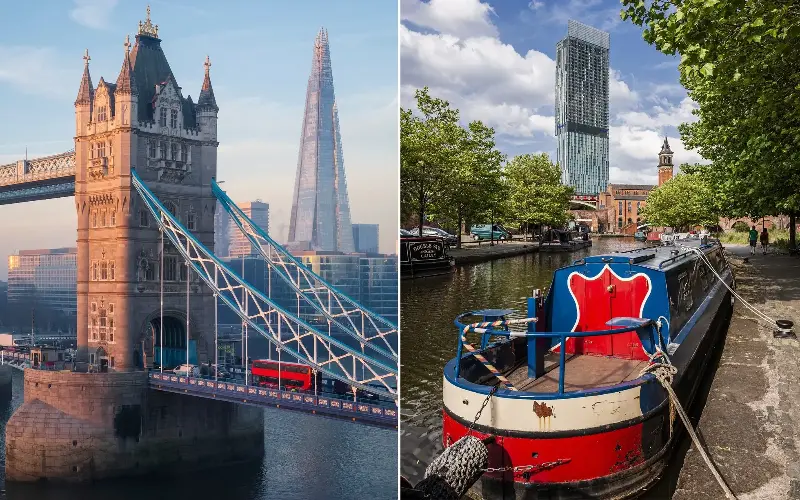
Manchester has been in the media a lot lately. “Manchesterism” is a dead cert to become Word of the Year. Even London-centric Tube map nerds have heard of the Bee network (not surprising given how much buzz Andy Burnham has generated around it).
In fact, even before the current potentially seismic shift in politics and a new focus on the devolved north, Lancashire’s biggest city was making headline news – whether for Oasis’s reunion tour, tussles in the top-flight of football, or the booming construction scene that’s turning the redbrick Cottonopolis into a curious hybrid of Canary Wharf, Hackney and Amsterdam – with bike lanes, canal towpaths and clanging trams.
Few question Manchester’s status as second city. Its metro area is bigger than Birmingham’s. Its voice is definitely louder – some might say gobbier. Plus, it’s further away from London – and with the demise of HS2, liable to remain that way – and up for a challenge.
So are we – and we think it’s timely to ask: which city is best for all the things people look for on a great city break, from food and all-round fun to culture, welcoming locals and getting around?
Food and drink
Winner: Manchester
Manchester’s best pubs are so far out of the league of London’s boozers that there’s no contest. The Briton’s Protection, Peveril of the Peak, Marble Arch, Old Wellington, Hare and Hounds and Unicorn Hotel are listed, heritage-rich pubs that have not degenerated into selfie-hellholes.
Then there are seedyish early evening pubs all round Victoria station. There are plenty of smart bars like Atomeca, Cloud 23 and Maya Manchester for cocktails and Cestrian poseurs. Food-wise, of course a city with a metro population of almost 10 million has more places to eat than one with not quite three million. The concentration of city bankers and brokers, executives, senior civil servants and celebrities in London means there is a glut of Michelin-starred restaurants and flash hotel eateries like the Dorchester’s Sushi Kanesaka (tasting menu: £420).
But Manchester has a smattering of all kinds of dining, from one-starred mana (tasting menu: £175) and Skof (tasting menu: £130), to innovative Higher Ground and solid non-chain places turning out Spanish, Korean, Thai, French and Modern British. Pub grub is better in Manchester, and there is less of the gastro-pub vibe of drinkers-not-welcome.
Museum and galleries
Winner: Draw
You can’t fault the collections at the National Gallery, V&A, National Portrait Gallery, British Museum, Natural History Museum and Tate Britain. They’re world-class, must-see, major showcases. But going to see art and artefacts is about the quality of the experience as much as the size of the offering. Too many people crowd into these institutions to allow visitors anything like the space and tranquillity to enjoy, learn about and reflect on what they see. Blockbuster shows about Bowie and big-name artists have become predictable and costly to visit.
Manchester City Gallery, The Whitworth and esea contemporary are smaller but well-managed, expertly curated spaces. The Manchester Museum was crowned European Museum of the Year in 2025. Manchester’s four great libraries – Chetham’s, John Rylands, Portico, Central – are wonderful, and three are free to enter. Over two days, you can see all these, on foot, and still have time for quirkier sites like Ordsall Hall, People’s History Museum, Elizabeth Gaskell’s House and The Lowry.
Shopping
Winner: London
Money, mercantilism, class and consumerism have made London the peerless capital of a nation of shopkeepers. If you want an antique atlas, a formal suit, a one-off piece of haute couture, £1,000 shoes or undies, you can find them here.
Oxford Street is a weird mess crying out for regulation and other once-storied retail thoroughfares can disappoint, but Harrods and Selfridges are still dizzyingly varied department stores, while Manchester’s Harvey Nichols is underwhelming and even a bit tacky – and, grimly, the city’s big John Lewis is out at the hideous Trafford Centre.
Both cities have a fair sampling of independent outlets, but again London has a better spread of shops in its immediate periphery – zones two and three on the transport network. Manchester’s sick-coloured Arndale is as dreary inside as out.
Tourist attractions
Winner: London
This is arguably the most subjective category. Is Trafalgar Square a “tourist attraction” or a pigeon-poo-stained void? Is Westminster Abbey spoilt because it has become a tourist attraction? Is Old Trafford a worthy object of pilgrimage? Does hunting for the historic addresses of Factory Records count as tourism or psycho-geography?
Both cities have old buildings and magnificent churches. London has palaces and grander architecture. If Manchester had retained a proper “cotton mills district” of redbrick behemoths – something akin to Hamburg’s Unesco-listed docklands – it could have pulled in big numbers as a tourist destination.
When the old Granada Studios operated a proper tour, it could compete with anything in London. The current Coronation Street Experience in Trafford Park is fun, but not comparable. London is the UK’s tourism central.
Welcoming locals
Winner: Manchester
Stereotypes shunned, clichés cast aside, it’s still irrefutable that Northerners are friendly. Lancastrians, in particular, are urbane, chatty and witty. Mancunians can be forthright to the point of cocky, but they will always help a visitor and Manchester pubs are full of people talking to strangers. For all the migration and ethnic mixing that’s gone on, a community spirit persists – and snobs, snoots, prigs and pompous types are objects of derision.
Sport
Winner: Manchester
Six of the 12 clubs that founded the English Football League were from Lancashire, Manchester’s mother county; none were based in London. Since the launch of the Premier League in 1992, Manchester United has won it 13 times, Manchester City eight times. The two clubs head the pack, followed by Chelsea, Arsenal and Liverpool.
Old Trafford is the largest club stadium in terms of capacity. The National Football Museum is housed in Manchester’s Urbis building. In 2002, Manchester hosted the largest ever Commonwealth Games in terms of participating nations, with 72 countries taking part across 14 individual and three team sports.
Manchester sits at the epicentre of the UK’s rugby league axis, often characterised as the M62 code – formalised as a rejection of London-centred public-school-rules “rugger”. Old Trafford is the home of Lancashire cricket. Manchester’s velodrome is the home of British cycling. London has Wembley, Twickenham and Wimbledon on its outskirts – iconic, for sure, but not exactly “local” shrines or temples of talent.
Transport
Winner: London
With none of the billions of funding granted to London to build the Elizabeth Line and refurb the mouldering Tube lines, Manchester has pulled off a few coups. Its Bee bus network covers 400 miles and tickets cost just £2 for adults and £1 for children. The Tram system connects the city centre to Altrincham, Ashton, Bury, Didsbury, Rochdale and the airport. A free number one bus runs all day, linking the main stations and city quarters. Drivers don’t pay to come in and you can park on one of the brownfield sites in Ancoats for as little as £7 per day (12 hours).
London has a solid bus network of its own and a serious, substantial rail system, with regular, all-day, fastish trains. Manchester needs a lot more bike lanes, a proper mapping of its footpaths and canal towpaths, and generally a greener approach to transport if it is to compete.
Outdoor space
Winner: Draw
London has better parks than any city in the UK. Royalty has ensured this legacy, refusing to allow railways and roads to pass through the centre or across ancient hunting chases. But to get quiet, truly clean green space you need to go either to the south-west of the city – along with everyone else – to find rus in urbe in Richmond or Home Park, or else schlep outside the M25 and seek fields and little hillocks in the Home Counties.
By contrast, Manchester is ringed by wildish moors, including the protected swathes of the Peak District to the east, the West Pennine range and main Pennine spine on the Yorkshire border, and, farther to the north and west, Pendle Hill, the Bowland Fells and the Dales.
Access campaigning began at Winter Hill, Darwen Moor and Kinder Scout (to the tune of “I’m a Rambler, I’m a Rambler, from Manchester Way”) and you really cannot compare the view from Primrose Hill of the Big Smoke with the more exhilarating prospect of Manc-hattan as espied from the Chew Valley in Saddleworth. Last year, the opening of the GM Ringway provided Mancunians with a 200-mile orbital connecting the city centre to the 10 boroughs of Greater Manchester.
Music and nightlife
Winner: Manchester
From Unesco’s Creative Cities Network to the homegrown Manchester Music City network, there’s official recognition of Manchester’s elevated status as a birthplace of popular music – no mean feat given Liverpool’s claims in this sphere. The Factory-Madchester-Britpop period of 1978-1997 saw punk and post-punk bands, labels, gigs and albums energise several scenes now regarded as seminal in British culture.
More importantly, the city still has a kicking live music scene, topping Time Out’s most recent ranking, with venues ranging from the massive Co-op Live to legendary Band on the Wall to intimate Gorilla. Classical music, dance and theatre are well catered for, and the ENO, gradually shifting its focus northward, will bring Philip Glass’s Einstein on the Beach to the Aviva Studios next year.
Value for Money
Winner: Manchester
Manchester came mid-table in the latest Which? survey of best large cities for a short break, with hotels coming in at an average of £99 per night (London was £127). A Numbeo comparison of the two cities for everyday weekend-break items like a restaurant meal, pint of beer, coffee and bottled water – as well as fresh food, transport, rent and cinema tickets – saw Manchester win on every single count. You will save between 15-30 per cent if you have a weekend in Manchester over London.
The verdict
With six votes for Manchester and four for the capital, it’s quite a close thing, as you’d expect. Manchester is a bit shabbier than grand old London, but a lot friendlier. It has less choice, but is cheaper. It is more fun and still less driven by class and connections. You can get around London a lot more easily on its nifty transport system, but, frankly, you can walk to most places in Manchester. For a weekend or short break, both are superb – but the Northern city just nicks it for value for money and basic vitality.
Chris Moss is the author of Lancashire: Exploring the Historic County that Made the Modern World (Old Street) and Where Tourists Seldom Tread: Postcards from Bypassed Britain (Faber) – both available at the Telegraph Bookshop.