



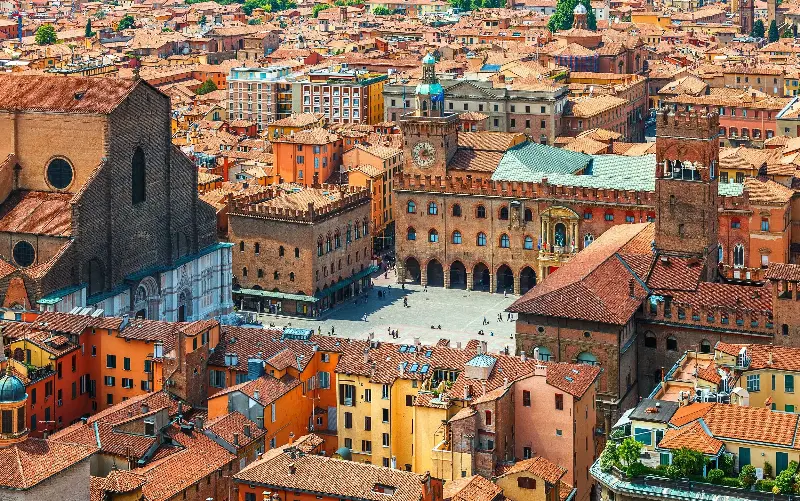
Food, food and more food – Bologna’s role as Italy’s gastronomic capital is very much in evidence with markets, delis and eateries every which way you turn. Raise your eyes from the goodies, however, and you’re rewarded with one of Italy’s best preserved medieval centres with a wealth of majestic palazzi and towers, including the distinctive pair that is the city’s most iconic symbol.
Another feature that characterises Bologna are its porticoes, a collective Unesco World Heritage site measuring nearly 38 miles altogether (including the world’s longest) and ensuring protection from the rain and snow as well as from the hot summer sun.
Find things to do by category:
Best for sightseeing
Bologna’s medieval towers
Get a bird’s eye view of the city
A couple of dozen of the 100 or so towers that defined Bologna’s medieval skyline, built both for defence and prestige, are still standing. The privately owned 60m-high Prendiparte tower now offers exclusive accommodation while the nearly 320ft-high Asinelli, the city’s tallest, is currently closed due to long-term stabilisation work on its neighbour, the steeply-leaning Garisenda tower. The iconic pair, the Due Torri, are a distinctive city symbol.
Insider tip: For more rooftop panoramas go up the San Pietro cathedral bell tower or the clock tower of Palazzo d’Accursio in Piazza Maggiore; alternatively visit the roof terrace bars at Hotel Metropolitan or Hotel Touring.
Website: bolognawelcome.com
Price: £
Piazza Maggiore
See the city’s cultural centres
Piazza Maggiore is the hub of city life now as it was in Roman times when the forum was here. The huge San Petronio basilica dominates, while Palazzo d’Accursio houses the city hall and municipal art collection. Opposite the church, the arches of Palazzo del Podestà host whispering corners and link to Piazza Nettuno with its grand 16th-century Neptune fountain and Salaborsa library, which has an underground archaeological site.
Insider tip: While Neptune’s trident provided inspiration for the Maserati sports car logo, the dialect name for the giant statue, Zigant, has been adopted by local winery Lodi Corazza for the excellent Pignoletto Superiore DOCG.
Website: bolognawelcome.com
Price: Free
Santo Stefano
Explore the Seven Churches
Legend has it that San Petronio, the city patron, built the octagonal Basilica del Sepolcro, one of the succession of adjoining churches that makes up the Santo Stefano, or Sette Chiese, complex, when he was Bologna’s bishop in the fifth century. Other features include a two-tier Romanesque cloister, supposedly a favourite spot of Dante’s when in Bologna, and the curious tomb of a tailor, bearing real scissors, in the courtyard.
Insider tip: From the cobbled, triangular Piazza Santo Stefano, where a popular antiques market is held the second weekend of each month, walk through the elegant Corte Isolani arcade to Strada Maggiore, coming out under a high portico which, according to legend, has three arrows in its wooden ceiling.
Website: santostefanobologna.it
Price: By donation
Sanctuary of the Madonna di San Luca
Take the pilgrim’s trail
A city symbol and beacon to homecoming Bolognese, the round baroque basilica of San Luca stands proud on a hill south-west of the city. If you have the time and energy walk the steep, three-mile route from the centre, which includes the world’s longest portico with over 600 arches; alternatively take the land train from Piazza Maggiore. Climb the church dome for even more spectacular views over the city and surrounding hills.
Insider tip: Just beyond the church the Vito bar and pizzeria is the perfect place to relax and refuel at the top before making your way back down the hill.
Website: santuariobeataverginesanluca.it
Price: Free (church); £ (dome)
Best for food
Quadrilatero and Mercato delle Erbe
Tuck into tasty market treats
Bologna’s colourful food markets are more than just for buying supplies, they’re ripe with atmosphere and flavour. Just off Piazza Maggiore the knot of alleys of the Quadrilatero has sold foods since medieval times; nowadays the delis, butchers and fishmongers serve their specialities too. The more spacious Mercato delle Erbe, where produce stalls take centre stage and eateries occupy the wings, is the locals’ choice.
Insider tip: If you’re around on a Saturday morning (Monday evening in summer) don’t miss Mercato Ritrovato, a farmers’ market with more, including cookery and craft classes, children’s activities and street food that’s anything but run-of-the-mill.
Website: mercatoritrovato.it
Price: £
Pasta-making classes
Learn culinary skills
What better souvenir than a new skill? Bologna’s deeply ingrained passion for fresh pasta is thriving, with the city now boasting more professional pasta makers than ever and many locals continuing to make their own (at least for special occasions). An abundance of courses are available in private homes, cookery schools and professional kitchens.
As well as making the pasta and cakes served at Atipico Osteria (also available to buy), Atipico Bottega offers hands-on pasta-making lessons, demonstrations and tastings. Some pasta shops serve their specialities freshly cooked too – try Sfoglia Rina, which is extremely popular for intriguing seasonal flavours as well as traditional recipes.
Insider tip: The official versions of more than 30 traditional recipes, including tortellini and green lasagne, are registered at Bologna’s Chamber of Commerce; there’s even a strip of gold showing the ideal dimensions of tagliatelle (just 8mm wide after cooking).
Website: phihotelbologna.com/en/atipico-bottega
Price: £££
Gelato Museum
Make your own gelato
Carpigiani, the Bologna-based producer of ice-cream dispenser machines used all over the world, has an on-site museum on the history of gelato. Book a tour combined with a tasting and making session to learn the difference between gelato and ice-cream, find out how tastes and techniques have changed over history, make your own gelato and enjoy the results. There are fun family experiences too, as well as the Gelato University where professionals from all over the world train and perfect their skills.
Insider tip: The on-site café-gelateria serves fresh flavours made daily.
Website: gelatomuseum.com
Price: ££
Best for history
Museum of the History of Bologna
Dive into local lore
A fascinating museum set in the majestic medieval Palazzo Pepoli in the centre of town, telling the history of Bologna from its foundation in the Etruscan era to the present day. Multimedia displays bring to life historic events including the coronation of Holy Roman Emperor Carlo V, which took place in Bologna in 1530, and aspects of the city such as its underground canal network. There are sections dedicated to local cultural traditions too, including famous foodie specialities.
Insider tip: The indoor courtyard café can be accessed even if you aren’t visiting the museum and it’s an evocative setting for a coffee or aperitivo.
Website: palazzopepoli.it
Price: ££
Archiginnasio
The University’s Renaissance heart
The 16th-century Archiginnasio was built in a move to bring the different faculties of Bologna University (founded in 1088) under one roof, and housed them until 1803. Around 6,000 coats of arms representing prestigious professors and students of the past cluster throughout. The wood-panelled anatomical theatre is where anatomy lessons took place at a central marble-topped table; its walls are decorated with impressive wood carvings of illustrious medics with the odd macabre touch, and symbols of zodiac constellations adorn the ceiling.
Insider tip: If plans to make the adjacent San Petronio basilica the world’s largest church had gone ahead, the Archiginnasio would have been destroyed. As it is, the church is Italy’s sixth largest and 10th in the world.
Website: archiginnasio.it/lang/en/visita-l-archiginnasio
Price: Free (courtyard, staircases and corridors); ££ (Anatomical Theatre)
Basilica of San Domenico
Discover world-class art and history
Often overlooked despite its exceptional art and history, the Basilica of San Domenico was built by the Dominicans over the smaller church where their founder died. Artworks include the “Mystical Marriage of St Catherine” painted by Filippino Lippi and the tomb of St Dominic richly sculpted by Nicola Pisano with three sculptures by Michelangelo added later. The young Mozart played the organ still present in the Rosary Chapel.
Insider tip: The church’s magnificent inlaid wooden choir by Renaissance friar Damiano da Bergamo depicting scenes from the Old and New Testaments was described by contemporaries as the eighth wonder of the world.
Contact: Piazza San Domenico; 00 39 051 64 00 411
Opening times: Mon-Sat 7.30am-1pm & 3.30pm-8pm; Sat cl 7.30pm, Sun cl 7pm
Price: Free
Best for families
Ducati factory
Speed and style behind the scenes
Italy’s most stylish and powerful motorcycles have always been made at this factory, founded a century ago by the Ducati brothers. Book in advance for a factory tour to see the bikes being put together (it’s all done by hand) and learn some intriguing insights – fascinating even if engines aren’t your thing. The museum hosts winning bikes from the 1940s to the present and although the historic motorcycles on display are no-go, there are also four of the latest Ducati models at the museum reception for visitors to get on and try for size.
Insider tip: For more Ducati bikes and anecdotes, head to Rino’s Garage in central Bologna. Alongside the impressive (free) collection, there is also a small bar.
Website: ducati.com/ww/en/borgo-panigale-experience
Price: ££
Bologna’s parks and gardens
Enjoy the city’s green spaces
Bologna’s botanical gardens, among Europe’s oldest, were first founded in Piazza Maggiore in 1568 and moved to the current site in the university district in the early 19th century. It’s my favourite spot for a peaceful half hour away from the bustling streets of central Bologna. The city’s most popular park, however, is Giardini Margherita, between the Santo Stefano and Castiglione city gates, with a lake, large lawns and bars. If you have more time, check out one of the country parks a little further out, such as the lovely Villa Ghigi.
Insider tip: For a quick burst of green in central Bologna, Piazza Cavour has a small but lush garden, and the gelato sold at the piazza’s Cremeria Cavour is delicious.
Website: bolognawelcome.com
Price: Free
How we choose
Every attraction and activity in this curated list has been tried and tested by our destination expert, to provide you with their insider perspective. We cover a range of budgets and styles, from world-class museums to family-friendly theme parks – to best suit every type of traveller. We update this list regularly to keep up with the latest openings and provide up to date recommendations.