



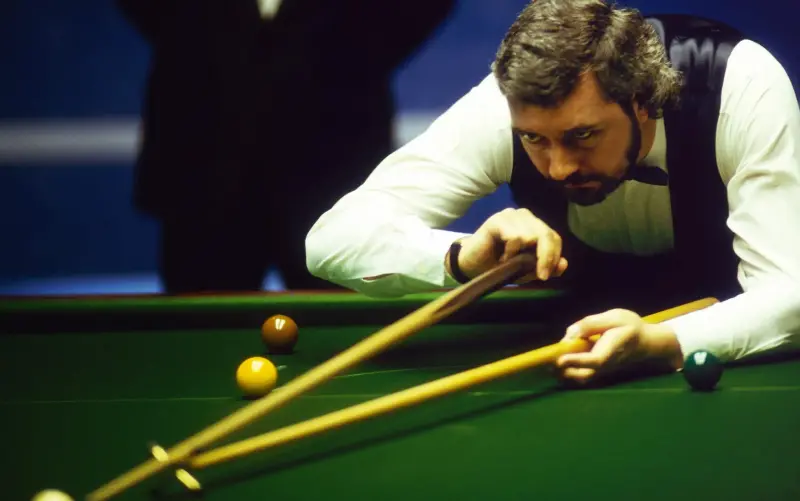
John Virgo, who has died aged 79, was an accomplished snooker player who achieved wider fame as a commentator and television personality, including appearing as a sidekick to Jim Davidson in the game show Big Break, which attracted 14 million viewers at its peak in the 1990s.
Big Break ran for 12 years on the BBC from 1991 to 2002, and was a roaring success with its combination of quiz questions and a finale in which leading snooker players potted balls against the clock to help contestants win prizes.
Virgo began the show as a referee and purveyor of trick shots, but his role expanded as he grew into the job and developed a double act with Davidson. By the end of the first series he had become a well-known figure in light entertainment, using the platform to become a guest on other programmes and as a year-in-year-out actor in pantomime.
As a snooker player Virgo had been ranked in the world top 20 for more than a decade from the late 1970s, and won the UK Championship in 1979. But despite frequent flashes of brilliance he was unable to find any long-term consistency, and never got higher than 10th in the world rankings. By 1990 his game had fallen into decline, after which he harnessed his wisecracking talents to make an income via other activities.
John Virgo was born in Salford in Greater Manchester on March 4 1946 to William, a crane driver in the docks, and his wife, Florence, a shop assistant. A postwar baby much younger than his four siblings, he grew up in an archetypical two-up-two-down terrace, with no running water, tin bath in the parlour and outside toilet.
His father bought him a small snooker table when he was eight, but later he was banned by his parents from playing in the local billiard halls on the grounds that they were dens of iniquity. That stricture still nominally applied when he left Ordsall Secondary Modern school at 15 to become a runner at an engineering firm, Banister Walton, but as adulthood beckoned he found the confidence to begin visiting the local billiard hall in Small Street, Salford, where his game improved rapidly.
In 1962 he won his first tournament, the British Under-16 boys’ Championship, and followed up with the 1964 British Youth Championship. Professional snooker was in the doldrums at the time, but he discovered he could add to his day-job earnings with money games in the evenings.
Over time the late hours played havoc with his work attendance, and after eight years with Banister Walton he was sacked. Managing to find a new administrative role at Miles Druce Metals in Trafford Park, he relocated to Rochdale, moving his allegiance to the Chorlton-cum-Hardy billiard hall.
When the one-frame Pot Black competition began on BBC TV in 1969, snooker leapt into the limelight, and in 1971 Virgo, as a top amateur, was invited to play in a Granada TV tournament. It was his first time on television, and he won.
The following year the newly minted world champion, Alex Higgins, sought him out at the Chorlton club, appearing unannounced to challenge him to a money match. Virgo won the lengthy encounter 39 frames to 25 and Higgins promised to pay up next time he was in town. But Virgo never did get the money, nor even the return of a jumper that Higgins took on loan before he departed into the cold Manchester night.
Spotting his telegenic qualities, Granada had asked Virgo to co-present a How to Play Snooker programme with Gerald Sinstadt, and his profile began to rise. Invited to take part in a tour of Canada with a group of professionals, it was there he discovered he could amuse the spectators. Having no cloth to wipe his cue, which had become sticky, with a deadpan expression he cleaned it with his tie, and the audience fell about laughing.
In 1976 Virgo accepted an offer to leave his job to help run Potters, a new snooker club in Chorlton, at twice his previous earnings. The same year he also turned professional aged 30. In 1979, his best year, he reached the semi-finals of the World Championship, where he lost 19-12 to Dennis Taylor, and then won the UK Championship against Terry Griffiths at Preston Guild Hall.
It was the highlight of his career, but victory almost turned into a nightmare when, with an 11-7 overnight lead in the final, he was late for the closing session the next day. Following the same leisurely routine he had kept up throughout the tournament at his out-of-town hotel, he was readying himself for the normal 1.45pm start when a call came through at 11.50am, asking where he was. It transpired that the final day’s schedule had been moved to accommodate the BBC’s Grandstand cameras and that Virgo, who had not thought to check the times, had just 10 minutes to get to the venue.
Despite a mad dash through traffic he was half an hour late for the start and was informed on his arrival that he had been penalised two frames. Booed by the audience and shaking with upset, he then lost the first two frames to bring the contest level, after which Griffiths went 13-12 up, leaving him with just one more frame for victory. Miraculously, however, Virgo somehow regained his composure to win the final two frames, snatching victory at 14-13 for his first and only major tournament win.
Not long afterwards Virgo was elected to the committee of snooker’s governing body, the World Professional Snooker and Billiards Association, and while there were other factors in his failure to sustain the form that led to the UK Championship, spending the next 10 years embroiled in the bitter internal politics of the game – two of them as the WPBSA’s chairman – was a distraction he could have done without. He won the Bombay International in 1979, too, and the Pontins Professional the following year, but nothing else of note over the rest of his career.
As a result, Virgo increasingly had to turn to other avenues to supplement his income. He sustained a regular summer job with Butlins, travelling around their holiday camps playing exhibition matches and performing trick shots, and it was on that circuit that he also began to do impersonations of players, a popular innovation.
Knocked out early in the 1984 World Championships, he was called upon by the organisers to entertain the audience – and millions of television viewers – following a quick finish to both semi-finals. His impersonations and jokes went down a storm, and overnight he became a recognisable personality beyond the confines of the table. In 1985 he was asked to commentate on the World Championship, and he remained behind the microphone for the next four decades.
Despite those positive developments, the bits and pieces of Virgo’s new existence hardly amounted to much in the way of income, and thanks to a serious gambling habit he was facing an increasingly dire financial situation. Just as he reached a nadir, however, the Big Break job came up. “I can’t overstate how much Big Break transformed my life,” he said. “Before landing that series I was in a black hole, wondering where my future lay.”
Although Virgo was a northern socialist and Davidson a southern Conservative, the two swiftly established a brotherly rapport, and as the first series progressed the host brought Virgo more and more into proceedings. Wearing extravagant waistcoats – he soon had his own line in John Lewis – and with catchphrase advice to “pot as many balls as you can”, Virgo made himself into a household name and was a key element in Big Break’s status as one of the most-watched UK quiz shows of all time, running to more than 200 editions.
Two years after its launch, he quit professional snooker to concentrate on his TV work and his annual pantomime roles, including an eight-year run with Davidson in Dick Whittington.
He kept up his connection with snooker as an ambassador for the game, drumming up publicity for forthcoming tournaments via radio and TV interviews, and continued as a popular commentator, known in particular for shouting: “Where’s the cue ball going?” if there was any danger of the white ball disappearing into a pocket.
He stole that phrase from one of his mentors, Ted Lowe, but with the keen instinct that sustained him throughout an eventful career in sport and show business, was able to make it his own by imbuing it with much more drama than Whispering Ted had ever done.
John Virgo’s first two marriages, to Susan and Avril, ended in divorce. He is survived by his third wife, Rosie, whom he married in 2010, and two children from his first marriage, Brook-Leah and Gary.
John Virgo, born March 4 1946, died February 4 2026