



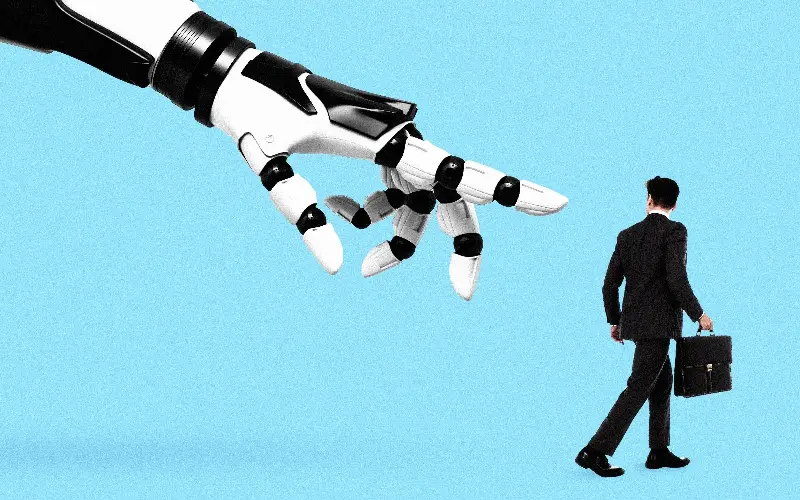
At Anthropic, the artificial intelligence (AI) business behind the Claude co-working bot, staff are increasingly uneasy about the power of their own creation.
In response to an internal survey in December, one Anthropic employee frets: “In the long term, I think AI will end up doing everything and make me and many others irrelevant.”
Another says: “It kind of feels like I’m coming to work every day to put myself out of a job.”
The impact of AI on jobs has been fiercely debated by tech leaders since the advent of ChatGPT three years ago.
In one camp, there are AI evangelicals who promise a golden age of productivity, where a booming economy means there is enough work for everyone – human and AI alike.
In the other, there are the doom-mongers warning that the world is on the edge of a jobs apocalypse.
Such fears have been brought into focus in recent days after Anthropic, a $350bn (£256bn) Silicon Valley AI lab, revealed a new feature for Claude that has sent tremors through global stock markets.
Last week, Anthropic launched – with little fanfare – a new tool called “plugins”. It has been billed as an assistant that can be easily employed as a “specialist to your role” in legal, marketing, finance, data analysis or customer support.
The tool is the latest type of AI “agent”, a semi-autonomous bot that can be unleashed to carry out business tasks with a few simple prompts and little human oversight.
These agents are part of a shift from AI bots that are simply question-and-answer engines into digital co-workers that can automate tasks across a computer – or even an entire company.
AI companies have been promising for the last three years – since the release of ChatGPT – that their tools could be about to transform the workplace, making it possible to do nearly all jobs that need a laptop with an AI bot.
That message appears to have finally got through. Anthropic’s latest release triggered an immediate shock wave through the stock market, wiping hundreds of billions of dollars from legacy software giants.
Shares have plunged in companies that develop mundane tools for accounting, legal services, data entry or digital marketing, such as SAP, Sage and Relx.
Advertising giants including WPP have joined the sell-off over concerns AI bots could see marketing and creative work automated. The one-time FTSE 100 stalwart has fallen 15pc since Friday.
Meanwhile, Rightmove is down 10pc since Friday over fears AI could upend house hunting.
A pair of US indexes that tracked software makers lost $300bn on Tuesday alone.
Until now, the AI “agents” being developed by Silicon Valley labs have been most popular among techies, start-up founders and engineers seeking hacks to speed up their work.
But Anthropic’s latest batch of tools is being specifically targeted at traditional white collar workers and city professionals. Lawyers, accountants and analysts could see their jobs up-ended by the new tech – or replaced outright.
The lab promised its new bots can take on “specific job functions like sales, legal and financial analysis”. The plugins are also designed so they do not require arcane coding knowledge to get them working.
Tech businesses embracing AI have already claimed agents can accelerate the work of entire teams.
Rob Seaman, the chief executive of office messaging app Slack, says: “We have teams of AI engineers with three or four agents working on their behalf.”
It is not just programmers. Barney Hussey-Yeo, the chief executive of UK fintech business Cleo, says: “Beyond the technical teams, how everyone works day-to-day is now augmented by AI.”
Dario Amodei, Anthropic’s chief executive and co-founder, has repeatedly warned of AI’s threat to traditional office work. Last year, he claimed it could eliminate as many as half of all entry-level white collar jobs in the coming years.
Even before his company’s latest product release, London’s professional class was already fretting about the impact of AI tools on their careers.
One City source says the outlook is “super worrying” for junior colleagues, with AI bots that can perform a typical due diligence task in “a tenth of the time” it would have taken a human.
Human co-workers, meanwhile, are finding themselves so reliant on AI bots that junior Gen Z staff fear being deskilled and made obsolete by the very bots they have been encouraged to use.
Liz Kendall, the Technology Secretary, acknowledged the fears around professional jobs last week.
“Across the country, people are already worried about the impact of AI on entry level jobs for graduates in areas like finance, business and the law,” she says. “I want to level with the public. Some jobs will go.”
There are tentative signals in the job market that suggest AI is starting to have an impact.
Official data published this month showed total administrative vacancies – the kind of role that is ripe for AI automation – fell by 36,000 over the past six months.
Meanwhile, jobs site Adzuna has seen a 35pc fall in adverts for entry-level jobs through to December 2025 compared with November 2022, when ChatGPT launched.
“As agentic AI takes on some routine administrative tasks, entry-level roles are being squeezed first,” says James Neave, head of data science at Adzuna.
A recent study from JP Morgan suggested AI was destroying more jobs in Britain than it was creating, with the investment bank saying the technology was responsible for an 8pc net loss in jobs.
If the latest agents are a step up from their predecessors for office work, these losses could rise.
Not everyone is convinced. Simon French, chief economist at Panmure Gordon, says he is “very, very dubious” as to whether the impact of AI has shown up in UK jobs data yet.
Tom Moore, a senior consultant at City headhunters Melton Legal Search, says the impact of AI on legal hiring so far has been “very marginal” – but he anticipates non-legal roles such as business development and secretaries could be at risk.
He adds if the tools prove more capable, it could “thin the ranks of associates” in the coming years.
Yet the threat to some of Britain’s premier software companies, including those in the FTSE 100, looks real and immediate.
The sell-off threatens to hit pension funds and savers who had bet on boring-but-reliable software stocks in what traders are calling the “Saas [software as a service] apocalypse”.
“Software companies are being indiscriminately put into an ‘AI loser’ bucket,” says Nay Soe Naing, a technology analyst at Berenberg.
HgCapital Trust, a specialist investor in business and accountancy tech, has been the worst performer on the FTSE 350, down 21pc since Friday.
Finsbury Growth and Income Trust, run by star stock-picker Nick Train, holds 45pc of its portfolio in Relx, Sage, Experian and the London Stock Exchange Group, all of which have endured a brutal sell-down.
Amid the accelerating rout, tech luminaries have sought to quell fears that AI bots will eliminate the need for the kinds of accounting and legal software tools that have been central to white collar office work for decades.
Jensen Huang, the Nvidia boss, insisted that the software sell-off was “illogical” and contended that AI bots will still need to rely on other tools to perform roles similar to human office work.
Seaman, of Slack, says he sees the rise of AI agents “less in terms of job loss” and more as giving staff the space to do work that once got “left on the cutting room floor”.
An Anthropic spokesman declined to comment on the market sell-off.
Yet if the creators of its Claude tool are to be believed, it is time for office workers to brace for the arrival of their AI colleagues.