



Seasoned users of the London Underground have long had a soft spot for the Bakerloo line and its venerable, cushioned carriages, which date back to 1972. Travelling on the line does undeniably feel like a blast from the past – a journey back to a time when train interiors had just a little more class, and were just a hint less utilitarian.
It’s good news, then, for British nostalgia lovers, that similarly ancient carriages on Naples’ regional network have just been taken out of service (in favour of swish new Swiss ones), meaning the Bakerloo carriages are now the oldest operating extensively in any major European metropolis – and among the oldest anywhere in the world.
The Bakerloo carriages are expected to remain in use into the 2030s, so there is still plenty of time to ride them. But what of their equally intriguing peers?
Farther afield – from the old wood-panelled classics manufactured in East Germany in the 1960s, to the stainless steel wonders dating back to 1950s Canada – there is still plenty of railway stock operating on regular lines that conjures up the feel of an earlier era. Here are 10 examples to whet the appetite. Your carriage awaits…
Bakerloo line, London
The carriages operating on the Bakerloo line, which links Harrow & Wealdstone and Elephant and Castle, were built by British manufacturer Metro-Cammell between 1972 and 1974, first appearing on the line in 1972. They have an instantly recognisable retro-style interior and a mixture of seating styles, including longer centre-facing strips and small inward-facing pods. Extensively refurbished over the years, they are expected to remain in service until 2035.
Ticket to ride
A Bakerloo line journey costs from £3; see tfl.gov.uk.
NSB Class 69, Norway
There are some carriages still in use in Europe that are older than those on the Bakerloo line, but none serving such a busy metropolitan network. In Norway, NSB Class 69 carriages were first manufactured by the Norwegian firm Strommen Vaerksted in 1970 and brought into service a year later. For more than five decades they have been deployed on a number of commuter and regional trains. The carriages are expected to be phased out by 2028.
Ticket to ride
NSB Class 69 carriages are used on several Vy services; see vy.no/en.
PKP Class EN57, Poland
When it comes to longevity, few can hold a candle to this much-loved train, which has been serving travellers in Poland since 1962 – just a year after its production began at the Pafawag works in Wrocław. With manufacture continuing until 1993, there are hundreds of PKP Class EN57 carriages still in service.
The trains are referred to locally as “kibel” (a rather crude nickname – it’s slang for “toilet” and supposedly stems from the original design, which drew “fresh” air into the carriages via the rudimentary onboard WC), or in the specific case of the EN57-038, “Babcia” (which translates to the rather more wholesome “Grandma”). Older units are expected to run into the 2030s, with modernised ones expected to run into the 2050s.
Ticket to ride
Regional operators Polregio and Koleje Mazowieckie both use EN57 trains; see polregio.pl and mazowieckie.com.pl.
Le Train Jaune (Yellow Train), France
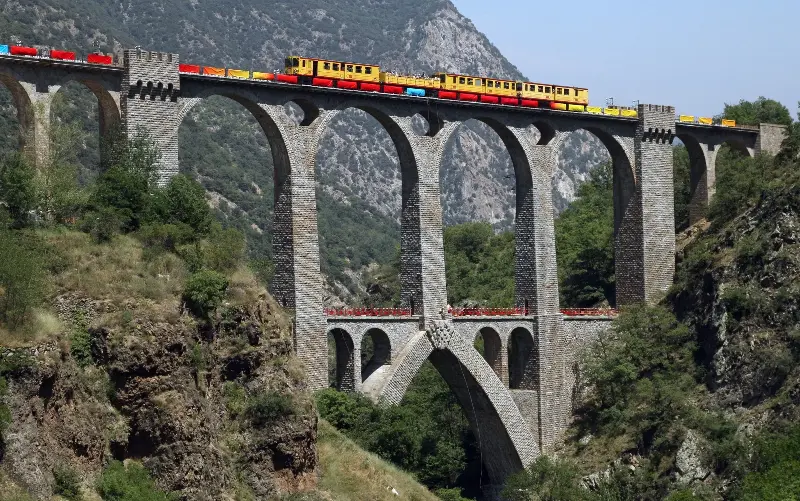
A more niche, but nevertheless regular, scheduled service, is Le Train Jaune, which plies a spectacular route in the Pyrénées-Orientales region of France, close to the border with Spain.
Many of the units on this train are of the Z 100 variety, open-air “barouche” wagons, manufactured between 1908 and 1909 by the Compagnie des Chemins de Fer du Midi and in service since 1910. There are more modern carriages too – Swiss-built Z 150 panoramic ones dating from 2004, but it’s the vintage ones that seal the deal.
Ticket to ride
Villefranche-de-Conflent to Latour-de-Carol costs €24 (£20.50); see letrainjaune.fr.
M1 line, Budapest
Another train often considered “heritage” is that which plies the M1 line in the Hungarian capital. There’s a lot of history on this particular line, which was officially opened in 1896 by the Habsburg Emperor Franz Joseph. Today, it is a regular part of the Budapest Metro system, while the distinctive Ganz MFAV yellow carriages used date back more than 50 years, having first entered service in 1973.
Ticket to ride
Single tickets on the Budapest Metro cost 500 Hungarian forints (£1.20); see bkk.hu/en.
Corona, Hungary-Romania
Central and Eastern Europe provides rich pickings for lovers of railway carriage nostalgia, with the Corona sleeper service between Budapest and the Transylvanian city of Brașov delivering in spades.
Manufactured in the East German railcar works in Görlitz in the mid-1960s, the train carriages, while undeniably tired, feature vintage wood panelling, red velvet curtains, and a dining car with an extensive menu that includes goulash soup and paprika chicken with dumplings. Sightings of Dracula may or may not be included.
Ticket to ride
Six-berth couchette bed from €39 (£33), single sleeper from €101 (£86.50). See mavcsoport.hu
VIA Rail, Canada
No selection of vintage rolling stock would be complete without mention of the stainless steel carriages still in regular service with VIA Rail across Canada. Some of these impressive train sets date back as far as 1947, though most originated in the mid-1950s.
Manufactured by the Philadelphia-based Budd Company, they have been modernised over the past 70 years, but the basic frame and feel remain the same. Sleeper-class passengers even have access to an old-style dining car.
Ticket to ride
A sleeper berth on the four-night Vancouver-to-Toronto run on The Canadian costs from 2,500 Canadian dollars (£1,320). See canadarail.ca
Metra, Chicago
The notoriously windy metropolis of Chicago is also home to some fine Budd Company rolling stock – the well-known bi-level trains in use today on the city’s Metra commuter rail network.
The carriages were originally built for the Chicago, Burlington and Quincy Railroad and the oldest in use – some of which still have their vintage railroad markings – date back to 1953. They are called “gallery cars” because the second floor features a mezzanine-type arrangement originally intended to help conductors identify boarding passengers.
Ticket to ride
A journey on the Metra costs from $3.75 (£2.80); see metra.com.
Hankai Tramway Mo 161, Japan
Should you find yourself visiting the Sumiyoshi Taisha Shrine in Japan’s Osaka Prefecture at the beginning of the year, you may well be transported there on board one of the region’s ancient tram cars, now almost a century in service. These picturesque trams, constructed from iron plates and wood in 1928 and have witnessed much of the past century.
From a total of 16 cars, four remain in service. Fully refurbished, they are used for chartered and public services, the latter especially during the first three days of the year for visits to the Sumiyoshi Taisha Shrine.
Ticket to ride
A flat fare of 240 yen (£1.10) is payable on board.
Mitsubishi Eidan 500, Buenos Aires
Another example of Japanese manufacturing prowess is found on Line B of the Buenos Aires Underground (Subte) network. Here you will spot many carriages of the Mitsubishi Eidan 500 type, manufactured in Japan between 1953 and 1965 and used for almost four decades on the Tokyo subway.
Argentina purchased 131 of the carriages in the mid-1990s, and they have been in use ever since. Originally sporting a red exterior with a white stripe, they have since been painted yellow, though on some there are still traces of the original livery and, inside, the traditional burgundy-coloured seating.
Ticket to ride
A single trip on Line B costs from 1,684 Argentine pesos (84p) with a SUBE card, more with other cards; see buenosaires.gob.ar.