



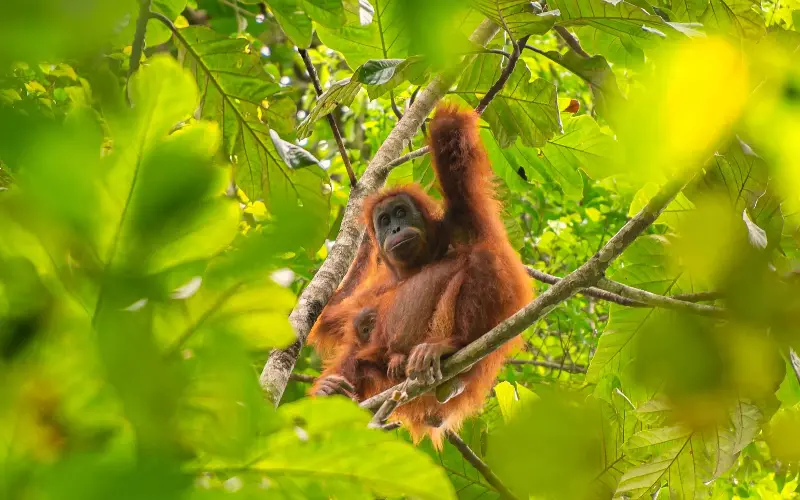
Four days of extreme rain and flooding killed 7 per cent of all Tapanuli orangutans, a study has found.
At least 58 of the critically endangered great apes died during Cyclone Senyar, which hit Indonesia’s western island of Sumatra for four days last November.
Some of the Tapanulis, a distinct species from other orangutans, were found buried amid debris, mud and logs, as their habitat collapsed and was swept away.
At least 1,200 people were killed and 300,000 homes were destroyed by Senyar’s rain, flooding and landslides in the deadliest natural disaster in Southeast Asia in 2025.
But the full effect on local wildlife has only just been revealed.
“If a few hectares of forest comes down in massive landslides, even powerful orangutans are helpless and just get mangled,” Deckey Chandra, who was working with a humanitarian team in the area, told the BBC.
He said: “It must have been hellish in the forest at the time. They used to come to this place to eat fruits. But now it seems to have become their graveyard.”
Tapanulis are one of three orangutan species. There are estimated to be 100,000 Bornean orangutans and 14,000 Sumatran orangutans.
Before the storm, there were estimated to be just 800 Tapanuli orangutans, living in three groups on Sumatra. At least 58 of them died.
The joint study by the Brunei-based Borneo Futures, World Weather Attribution and Liverpool John Moores University found it was possible that the death toll of orangutans was even higher, because the researchers had only surveyed one part of the forest.
The study used satellite images of the west block of Batang Toru forest and historical records of the orangutans to determine how many were likely to have been killed.
Erik Meijaard, the paper’s lead author and the managing director of Borneo Futures, said: “This level of loss is substantial for a species with such a small total population.
“When combined with ongoing pressures such as habitat degradation and human-wildlife conflict, it further increases the urgency of implementing and adequately resourcing a co-ordinated species action plan.”
The study said that the effect of the storm had been worsened by deforestation on the island, which had increased the intensity and frequency of rain, a claim supported by other environmental groups.
The heavy rain caused large parts of the deforested hillsides to turn into fast-moving landslides.
“Landslide patterns indicate rapid and highly destructive events that left any orangutans caught in landslides with little chance of escape,” the report said.
In December, Mr Meijaard estimated that the storm had probably killed approximately 35 orangutans, which was already a “major blow to the population”. The revised figure is even more serious.
The study warned that Tapanuli orangutans would go extinct if the population continued to drop by more than 1 per cent annually.
The Indonesian government has temporarily halted mining, oil palm farming and hydropower expansion in the Batang Toru forest.
The study called for an “immediate moratorium on land-use activities that degrade remaining habitat, alongside the expansion of protected areas around the west block and key corridors” as well as stronger legal measures to protect the endangered orangutans.