



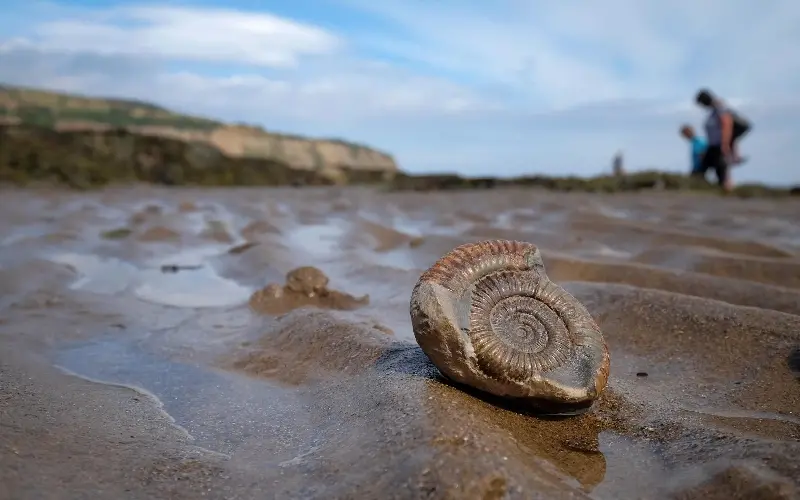
Britain is home to some of the best beaches for fossil hunting. The 96-mile-long Jurassic coast of Dorset and Devon, the Isle of Wight (also known as “Dinosaur Island”) and the Yorkshire coast are the main hubs. Quarries too – when accessed safely – are like fossil amphitheatres; their layers of rock stripped back to reveal prehistoric treasure.
Interest in fossil hunting has surged, with hotspots seeing more and more visitors from further afield, all searching for the remains of dinosaurs that roamed or swam here millions of years ago. These include the incredible two-metre-long Pliosaur skull with its 130 dagger-like teeth that was found not long ago in Dorset’s cliffs and is now on display at the Etches Collection in Kimmeridge.
Here, we’ve dug up five of the best fossil hunting locations in Britain.
1. Compton Bay, Isle of Wight
The Isle of Wight is “one of the best locations for finding dinosaur fossils in the UK”, says Prof Paul Barrett, a dinosaur researcher at London’s Natural History Museum. Some 130 million years ago, this island was a wetland of swamps where herbivorous dinosaurs foraged. Twenty fossil dinosaur species have been found, and counting. Two years ago, a new find, an iguanodontian, was described and named Comptonatus in tribute to the area. Last year, a new footprint of a sauropod – a herbivore that grew up to 20m in length – was unearthed.
For such a small area (147 square miles), the diversity of dinosaurs is the best in Europe. You may also find remains of animals that came later – such as a hornless rhino – as well as flint tools from prehistoric human residents. The southwest of the island, with the oldest Cretaceous rocks, is the best spot for fossil hunting.
National Trust-owned Compton Bay, backed by low, grass-topped multi-hued cliffs, is a beautiful sandy beach with cliff-top car parking and beach access via steps. An ice cream van is your only option for food or drinks. At the bottom of the steps, turn left and 380 yards further on, you find boulders that are casts of footprints of three-toed ornithopods. You may need an expert to point them out.
Best find? The skeleton of polacanthus, an armour-plated dinosaur found in 1979. You can see it in London’s Natural History Museum.
How to do it
The National Trust offers hour-long guided fossil walks with a local operator, Wight Coast Fossils, (£7.50) – your take-home finds could be fragments of fossilised dinosaur bones or teeth. Stay at Compton Farm campsite, a family-run campsite near Compton Bay.
2. Crail, Fife
Rocks here date from the Carboniferous period, 335 million years ago. There are fossilised tracks of what look like mountain bikes riding in parallel on the foreshore boulders. These are the trackways of an enormous giant multi-legged invertebrate, similar to a millipede, up to two metres in length. Such finds are known by palaeontologists as ichnofossils or “trace fossils”, the term given for fossils that are not bodily remains but rather marks left behind by animals.
There are also two huge fossilised tree stumps, or rather they look like tree stumps but are in fact club mosses which grew to tree-like dimensions in the Carboniferous period. Smaller fossils that you may find to take home include tree bark, roots and coprolite – fossilised shark poo.
You may need a geologist’s hammer to open pebbles. Wear protective goggles.
Best find? It’s hard to beat those track marks of the giant centipede.
How to do it
The UK Association of Fossil Hunters occasionally runs guided fossil walks at Crail and other locations around the UK. For two-hour geological walks tailor made for your group, email Crail geologist Rosalind Garton ([email protected]). Maximum of eight people per group. Accompanied children over eight years welcome. Walks may be tide dependent (from £120). Crail Harbour Gallery and Tearoom is a characterful café with sea views. Stay at The Shoregate.
3. Saltwick Bay, Yorkshire
The geology of the North Yorkshire coast is the northern equivalent of the Dorset Jurassic coast, specifically that found around Charmouth. “Whitby to Saltwick Bay is the best section for dinosaur footprints,” says geology guide, Steve Cousins, “and when combined with the common ammonites and much rarer marine reptiles, makes the stretch a very special location for finding fossils and studying Jurassic ecosystems.” All of Whitby to Saltwick Bay is an SSSI. Last year Steve found the footprint of a stegosaur.
As with all fossil hunting locations, the area is best explored after storms, which not only dislodge new material from the cliffs but also scour sand away from the shale beds. “New” ammonites, Jurassic plants, marine reptile bones and dinosaur footprints are often being uncovered.
Best find? There have been some special finds along the Yorkshire Coast including very rare dinosaur footprints with claw and skin impressions.
How to do it
Yorkshire Coast Rocks leads fossil safaris at Saltwick Bay and elsewhere on the Yorkshire coast. A private three-to-four-hour safari with a scientist costs from £195 for up to six people. Alternatively, join one of its public walks for £25 for adults and £12.50 for children. Stay at Whitby Holiday Park, from £459 for a three night stay in a glamping pod with a hot tub.
4. Lyme Regis, Dorset
With their tilted strata, meaning you walk a million years in a mile, the Jurassic cliffs of Lyme Regis were the birthplace of palaeontology in the 19th century with Mary Anning’s many fossil finds. Britain’s most complete dinosaur, Scelidosaurus, was also found here. Soft, storm-lashed cliffs are constantly disgorging easy-to-find treasures onto the beach, such as ammonites, belemnites and gryphaea, or “devil’s toenails”, a type of extinct oyster species.
Rubbish from the town’s historic dump, in use from Victorian times until the 1970s, is also tumbling beachward. Surprisingly perhaps, finding human detritus assists fossil hunting. Heavy items such as old pen knives and nails get washed together by tides and here, too, you will find fossils dense in iron pyrite – shiny little ammonite jewels of “fool’s gold”.
Afterwards, head to town and uphill to the Alexandra Hotel for a cream tea al fresco with harbour views.
Best find? Recently a rare fragment from the world’s oldest marine crocodile turned up on one of the museum’s guided walks. Heather Salt, a tourist, was taking part in a walk when she made the discovery – a piece of upper jaw bone from the rare marine crocodylomorph.
How to do it
Lyme Regis Museum leads three-hour fossil-hunting walks that cost £18.95 for adults and £12.75 for children. The 2026 edition of Lyme Regis’s annual Fossil Festival takes place June 13-14,with talks, exhibitions, performances, walks and more. Stay at the Alexandra Hotel (doubles from £161).
5. Upper Gilwern Quarry, mid-Wales
On private land on the edge of Bannau Brycheiniog, also known as the Brecon Beacons, this former quarry offers guaranteed finds of Ordovician trilobites of the genus Ogyginus (they look like giant beetles), up to 469 million years old. A local extinction event, possibly a volcanic eruption raining down ash, killed and preserved tens of thousands of the creatures at what was probably a breeding site in a shallow sea.
Guests who stay at accommodation belonging to the landowners have exclusive access to the quarry. A shepherd’s hut on site has far-reaching views. Another option is two “treehouses” that each sleep seven, located 10 minutes’ drive away. Your party gets half a day’s fossil hunting at the quarry included in your stay.
Best find? That would be a trilobite.
How to do it
Stay at Upper Gilwern Quarry shepherd’s hut which sleeps up to four and costs £150 for one night. Minimum stay three nights. For more spacious accommodation, try Rhiw Wood Treehouses.
This story was first published in May 2024 and has been revised and updated.