



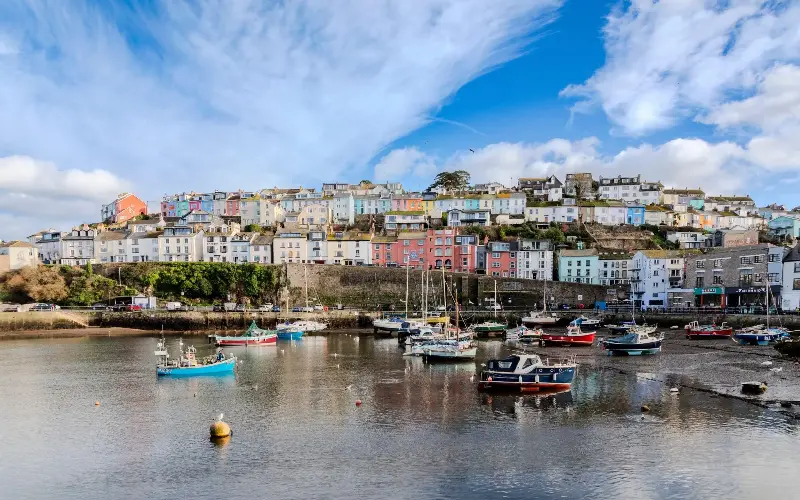
Basking in glorious weather, many of our great British seaside resorts are now in full flow. But have you ever wondered what lies beyond the intertidal zone, where we splash and cavort for fun? Head half a mile or so out to sea and you might be surprised to find that this summer’s warmer temperatures have ushered in new denizens of the deep.
The English Channel is gossamer-smooth and wreathed in sunshine on the fine Devon morning we set sail. Captain Ross Parham glides his 42ft catamaran, Spot On, into Brixham harbour, skirting the bright red-and-blue hulls of one of England’s largest fishing fleets. Alongside 10 fellow passengers, I’m heading out for a full day of marine wildlife watching off the westernmost fringe of beautiful Lyme Bay.
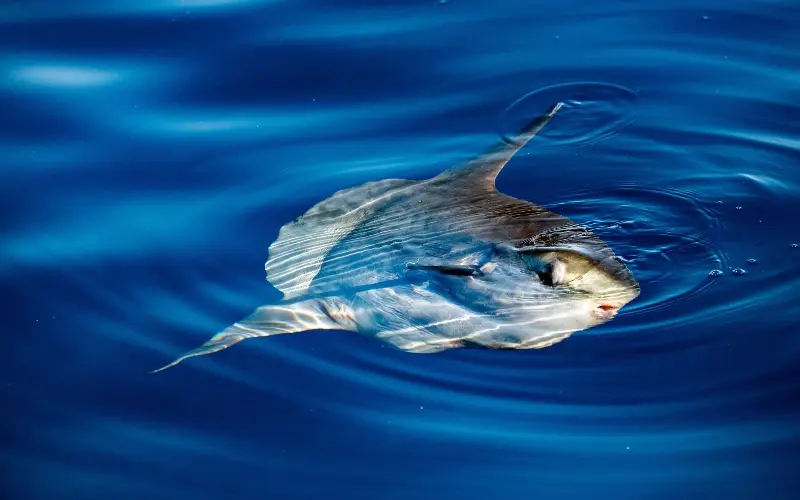
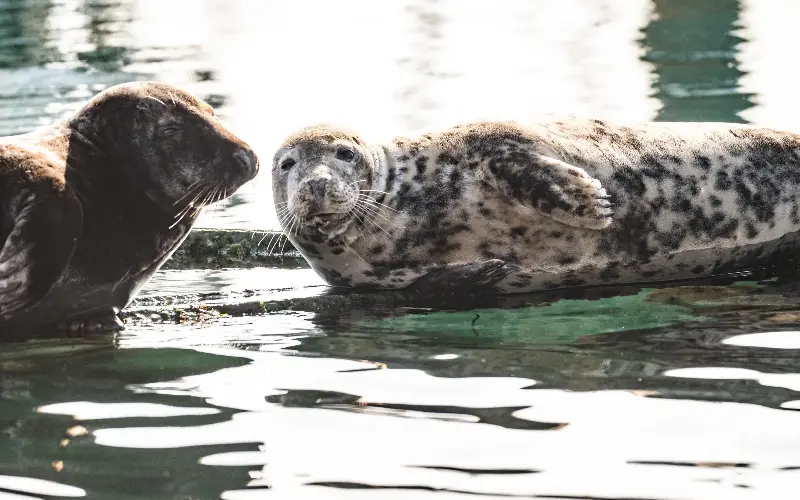
We’ve scarcely left the harbour, where plump grey seals are balanced like trapeze artists on narrow struts beneath an old jetty, before Tom Brereton, our naturalist guide, calls out the most bizarre leviathan in all our coastal waters: a dorsal fin is breaking the sea’s surface, waving back and forth as if trying to attract our attention.
Sunfish defy all laws of hydrodynamics. They are among the heaviest bony fish in our waters, capable of reaching 10ft in length and weighing several thousand pounds. Looking spherical in body shape, with no tail and bulging brows, they use a large dorsal fin above their back and an identical anal fin on their underside in tandem to propel themselves along like a rowing boat on its side. Evolution, in their case, simply lost the plot.
It drifts towards our catamaran, staring straight towards us with a large, dark eye. This is a relatively small sunfish, but Parham says they can pack on 1.8lb per day in captivity. It’s come to the surface to bask in the sun, warming up from deeper waters where they feast on the coast’s abundant jellyfish. “They get so close you can almost pat them,” adds Parham.
Bow-riding dolphins from the Bay of Biscay
“It’s a boom period for such wildlife, with warming sea temperatures and northward shifts from the Bay of Biscay bringing food sources such as anchovies, octopus and jellyfish,” explains Brereton. “We still have most of the traditional species (auks, terns, porpoises and gulls), but these are being complemented by a huge influx of formerly scarce species, such as sunfish.”
His words soon ring true. We skirt Berry Head’s steep cliffs, once fortified in the late 18th century when Napoleon was running amok, then cruise the teal-blue sea offshore of the Dart Estuary towards Start Point Lighthouse. I’d sailed out here a few years back and had been surprised to run into a large pod of common dolphins. Now they are truly commonplace, and throughout our day every one of the myriad pods we encounter playfully rides our bow.
These sleek animals possess darkish backs with a white underbelly that can look yellowish, like nicotine staining. Their lack of effort in outpacing us, a muscular wiggle of their small bodies, is utterly entrancing. One of my fellow travellers watching them is in tears. “They’re the world’s fastest dolphin, capable of 40 miles per hour,” says Brereton.
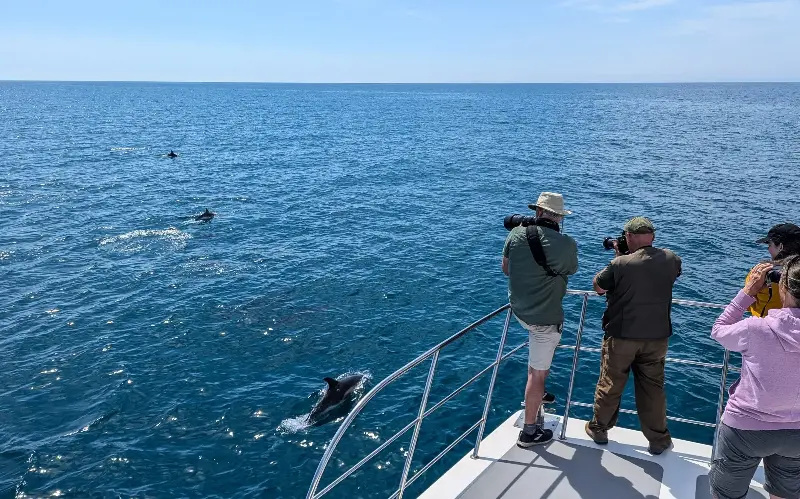
They are also opportunistic. Our more traditionally seen cetacean in the Channel, the white-beaked dolphin, is now migrating north due to its intolerance of seawater much above 17C, so common dolphins are arriving in greater numbers from the Bay of Biscay. Channel temperatures this summer have been recorded several degrees warmer than average.
Spotting Balearic shearwaters
As Devon’s sun-parched coastline becomes ever more distant, we sail into a feather storm of seabirds. We admire diving gannets bearing the profile of Concorde, guillemots, or “jumplings”, as they are endearingly called, fresh from their fearless first leaps off their cliff-ledge nests, plus punchy little razorbills whose hooked boxer’s nose and black attire lend them the air of nightclub bouncers.
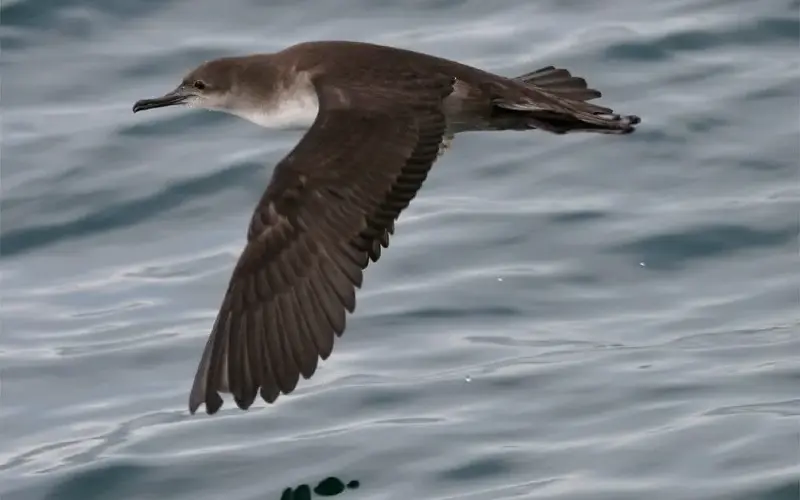
The Balearic shearwaters, however, are the star turn. These small, greyish-brown seabirds with pale underbellies glide close to the sea’s surface. Now one of Europe’s rarest, this critically endangered seabird, jeopardised by drowning in fishing nets and predation of their eggs by rats, is thought to have fewer than 3,000 breeding pairs left.
Yet they too are finding succour in the English Channel. “They breed in Menorca and Ibiza, but are now following the warmer temperatures north,” explains Brereton.
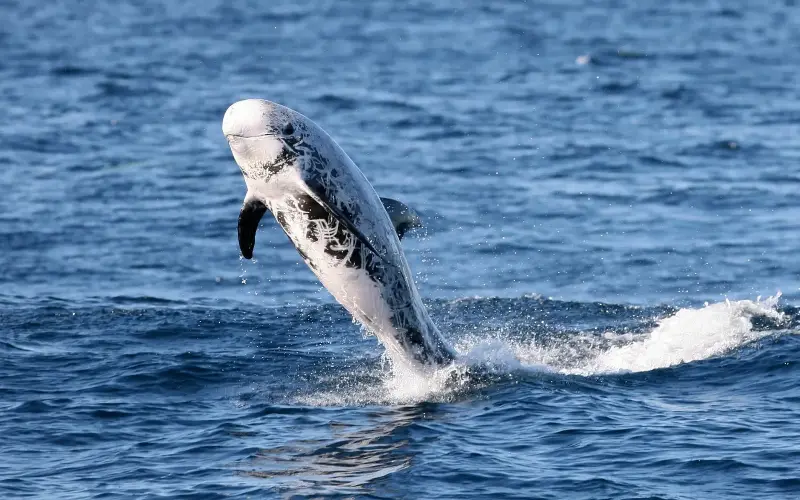
This Balearic influx is further added to by a hefty critter that, momentarily, because of its erect, tall, black dorsal fin, tricked me into believing it was an orca. Named after an obscure 18th-century Italian naturalist, Risso dolphins are truly impressive beasts. We start seeing pods of them in deeper water, several miles into the Channel. They launch with what seems like frivolous joy above the sea surface, with arching backflips and great splash landings.
These 12ft-long dolphins are solid units, with bulbous, wrecking-ball heads and heavily scarred bodies that look as though they’ve gone 10 rounds with the giant squid that grappled Nemo’s Nautilus. They’ve arrived in the Channel to feast upon the octopus saturating our coastal waters. Octopuses possess razor-sharp beaks, hence the Risso’s battle scars.
“A boat came into Brixham the other day with a £500,000 catch of octopus,” said Parham. He takes fishing charters out, but admits the likes of cod and mackerel are now in short supply. “It’s not just sea temperature rises – they’ve also been overfished,” he laments.
We turn for shore by late afternoon, imagining the Risso dolphins to be the last giants of the day. Then one of the group calls out: “Whale!” It’s a distant sighting, but they are increasingly likely as some of the planet’s largest whales, fins and humpbacks, are regularly seen transiting the Devon and Cornish coastline. After an onboard debate about this whale, Brereton declares it to be a 30ft minke.
The seals are still languishing in exactly the same spot by the time we sun-frazzled naturalists re-enter Brixham. Without trivialising what further changes rising sea temperatures may bring, not least for fishing, it was in 1 Corinthians 10:27 that the apostle Paul declared you can only eat what is put in front of you. And this exotic new cornucopia of wildlife was a feast to enjoy.
How to do it
Mark Stratton was hosted by Naturetrek (01962 733051). Its Seabirds and Cetaceans of Lyme Bay trip costs £135pp, including expert guiding and tea and coffee while on board. Trips depart from Brixham harbour at 8am, arriving back at 5pm, with indoor and outdoor seating. Regular summer departures.