



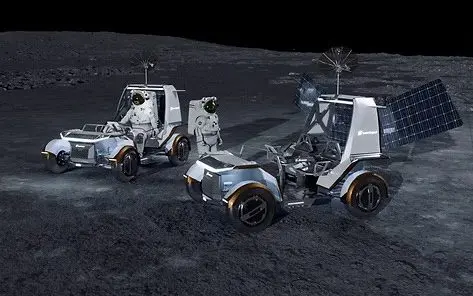
Humans are set to drive on the Moon again after Nasa unveiled new self-driving buggies for the lunar surface.
The US space agency wants to establish a permanent base on the Moon by the early 2030s, and this week released further plans.
Electric Moon buggies were used by astronauts on the Apollo 15, 16 and 17 missions for collecting samples.
As well as being driven by crew, the new vehicles will work autonomously to map the terrain, search for water and shuttle cargo to the Moon base.
Nasa wants them in place by the time astronauts land at the lunar South Pole in 2028.
The new buggies are a cross between the Apollo Lunar Roving Vehicles of the 1970s and the Mars rovers. They will be capable of travelling 125 miles from the Moon base – four times further than the original Moon buggies.
Carlos García-Galán, Nasa’s Moon base programme executive, said: “The LTVs [lunar terrain vehicles] will give astronauts the ability to conduct scientific research around the Moon.
“But it’s going to do a lot more than that, because in this case, we need it to work all year round [when astronauts are not there].
“We needed them to be on the surface doing things, to basically prospect at the surface, scope around to potential landing sites, or go to areas of deep scientific objectives.
“They can be robotically operated by people on the ground. They can work autonomously. And of course, when we have human crew missions, they will be driven by the humans.”
The rovers weigh in around one metric ton each – about the weight of a Fiat 500 – and need to fold up to fit into the landers. They can travel up to 6.2mph and go up slopes of 20 degrees.
The first design chosen is Astrolab’s Crewed Lunar Vehicle, or CLV-1, which resembles a small coach without horses, and can carry two astronauts.
It measures around 13ft long and 7ft 6in wide, and is designed to sit on top of the lander with its wheels folded upwards. It is deployed to the surface using an in-built crane on the lander, with its wheels unfolding before it hits the ground.
The second rover – named Pegasus – is being built by Colorado-based Lunar Outpost, which is working on the concept with General Motors and Goodyear.
Pegasus will be delivered to the surface in a compressed state, via a lift from the landing vehicle, before its chassis expands and lengthens once it reaches the ground. It can carry two astronauts.
Justin Cyrus, chief executive and founder of Lunar Outpost, said: “We’ve spent the better part of the past decade engineering advanced mobility solutions for the realities of operating and building on the lunar surface.
“Pegasus gives astronauts the range, reliability and flexibility needed to thrive in new terrain as we identify and prepare the sites that will become the first permanent lunar outpost.”
Nasa wants humans to live on the Moon within the next seven years and has begun transporting equipment to the Moon’s South Pole, in anticipation of the arrival of the first Artemis astronauts in 2028.
Over the next two years, pioneer probes and rovers will map the terrain, search for ice that could be used as water, monitor radiation levels, drill below the surface, hunt for useful resources and test communications.
From 2029 onwards – in phase two of the plan – construction of the Moon base will begin in earnest, with a permanent settlement by 2033 in phase three.
Several habitation modules are already in production, including the Italian Space Agency’s Multi-Purpose Habitat, which is described as “part rover, part lunar shelter”.
Jared Isaacman, Nasa’s administrator, said the $30bn (£24bn) project would be a mission dealing with the “epic science of survival”.
“The Moon is as beautiful as it is hostile,” he said.
Mr Isaacman added: “I’m often asked why we send our astronauts into such harsh and dangerous and unforgiving environments of space, or the lunar surface and at such great cost.
“We go for technology. What we will pioneer to get there, the science and all that we will learn, will make life better here on Earth.
“We go to advance humankind on this great adventure, to inspire the next generation to do it better than we can, and to master the skills for where we will inevitably go next.”
Nasa will use the Moon base as a testing ground for a mission to Mars.