



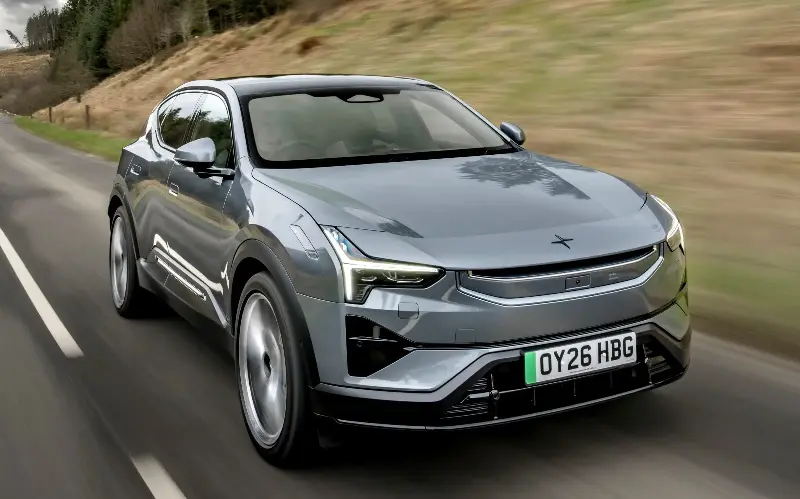
In a reversal of conventional automotive industry practice, the latest Polestar 3 looks almost identical to the previous version yet has been fully revamped beneath the skin; usually, a few styling revisions distract from limited mechanical, interior or software upgrades.
This large electric SUV feels as though it should be an upmarket product and carries vaguely Scandinavian overtones, even though the Swedish-headquartered Polestar is majority owned by Chinese investors and isn’t an established premium brand just yet.
The biggest news is the arrival of an 800-volt battery, allowing much faster charging. If you can find a charger rapid enough to match it, the 3 can take on energy at a lightning-quick 350kW in dual-motor form, or 310kW as a single motor. In real terms that means a charge to 80 per cent from 10 per cent can be performed in 22 minutes – adding a real-world 170 miles.
Pros
- Classy balance between body control and ride quality
- Smartly Scandi interior
- Loads of boot and passenger space
Cons
- Too much touchscreen; too few buttons
- Expensive even by the standards of premium rivals
- Quickest versions are arguably too fast
Faster charging
Battery capacities remain the same as before: 92kWh on the single-motor car, 106kWh for the dual-motor versions, giving a real-world range of about 280 and 305 miles respectively, although the dual-motor Performance model’s range drops to about 280.
Even the entry-level car has 328bhp, however, and can thrust you to 62mph in only 6.3sec. Opting for anything more merely amplifies the violence with which your kidneys attempt to exit your body rearward if you floor the accelerator; the 537bhp dual motor will do the 0-62mph sprint in 4.5sec, while the frankly unnecessary 671bhp Performance takes only 3.8sec. As with all superfast EVs, which deliver all that power instantly, experiencing this acceleration verges on the unpleasant.
So it’s best to stick with the base model, then – doubly so given that it now starts at more than £76,000. That puts it directly in the line of fire of the excellent, but aesthetically challenging, BMW iX as well as the Mercedes-Benz EQE SUV. So it had better be good.
Touchscreen hell
The seats set a good first impression. The nappa leather of our test car is an optional extra but a refreshing change from virtue-signalling “vegan leather”. They are incredibly comfortable, too.
There are almost no physical controls, however, which proves to be one of the 3’s greatest sticking points. The portrait-oriented screen is a good size, but accessing some of the functions requires a labyrinthine delve into a menu system that isn’t always intuitive. And because so many of those functions are controlled via the screen, some are inevitably buried deeper in submenus than you would like.
This extends even to the lighting controls. I know we motoring hacks sound like a stuck record on this, but any car that hides the switch for the rear fog lights within a menu, thus requiring the driver to avert his eyes from the road in poor visibility to switch them on, is prioritising design over safety.
It’s all the more disappointing that this zealous adherence to touchscreen dogma is the only real black mark inside the 3. The rest of the interior is beautifully finished with truly high-end materials that bestow a general sense of Scandi wellbeing, while the driver display’s simple white-on-black instruments are the epitome of clarity.
There are acres of space, too. The 3 is deceptively long, about as long as some seven-seat SUVs, in fact, but since all that space is shared by only five occupants, each has masses of room. There is plenty of luggage space, too. There are 598 litres all told, with the main boot of 484 litres ameliorated by a 90-litre underfloor storage area and a 24-litre cubby beneath the bonnet.
Suspension of disbelief
Even in this most basic form, the 3 is rapid. But despite that performance, it isn’t geared toward conventionally sporty behaviour. In fact, the way it’s set up clearly prioritises comfort. The suspension – another unseen area that’s had quite a bit of fettling as part of the facelift – does an admirable job of smoothing out even the worst imperfections.
In fact, I’d go as far as to say that this is now one of the best-riding electric cars. Not because it’s soft and cosseting, but more because the ride is so tightly controlled.
Bumps and ruts pass beneath the wheels with a little vibration, but nothing more, yet over larger crests the body stays beautifully tied down; there isn’t a hint of waft or wallow. And at higher speeds, the lack of wind and road noise is truly commendable. The 3 would be a delightful way to cross a continent.
In corners it’s a similar story. The 3 is aggressively neutral: huge on grip at both ends and nigh on impossible to get out of shape unless the road is slippy or you’re trying too hard. You simply prod the accelerator as much as you dare and guide the nose through bends with very little fuss, without much of a sense that either end is about to lose grip.
It isn’t what you’d call fun, yet the pin-sharp accuracy of the steering and the clinical way in which the suspension controls the body are admirable. The way a well-driven 3 can cover ground point-to-point is startling.
The Telegraph verdict
The 3’s strong leanings toward comfort and practicality might seem at odds with its astonishing turn of speed and its ability to hurtle along a back road with aplomb. Yet its abilities make it a compelling alternative to rivals, somehow making them seem overblown and overstyled by comparison. Trinkets and adornments are, mostly, kept to a minimum in favour of comfort, practicality and a strong sense of Nordic luxury.
It does feel like a premium proposition from within. It is also easier on the eye than many of these large EV SUVs, which goes some way toward justifying its high price. In fact, all it needs is a few more physical buttons and switches to be a class leader.
The facts
On test: Polestar 3 Rear Motor
Body style: five-door SUV
On sale: now
How much? £76,540 on the road (range from £76,540)
How fast? 130mph, 0-62mph in 6.3sec
How economical? 3.5mpkWh (WLTP Combined)
Electric powertrain: AC permanent magnet synchronous motor with 92kWh (usable) battery, 310kW on-board charger, rear-wheel drive
Electric range: 374 miles (WLTP Combined)
Maximum power/torque: 328bhp/354lb ft
CO2 emissions: 0g/km (tailpipe), 22g/km (well-to-wheel)
VED: £10 first year, £640 next five years, then £200
Warranty: three years / 60,000 miles
Spare wheel as standard: no (not available)
The rivals
BMW iX xDrive45 Sport
402bhp, 374 miles, £75,405 on the road
Bests the Polestar on looks and price and matches it on range. It’s not as roomy inside, however, nor can it charge as quickly.
Hyundai Ioniq 9 Long Range AWD Calligraphy
303bhp, 372 miles, £75,795 on the road
The top-spec Ioniq 9 is laden with equipment, all-wheel drive and two more seats for the same price. It feels almost as plush from inside, too.