



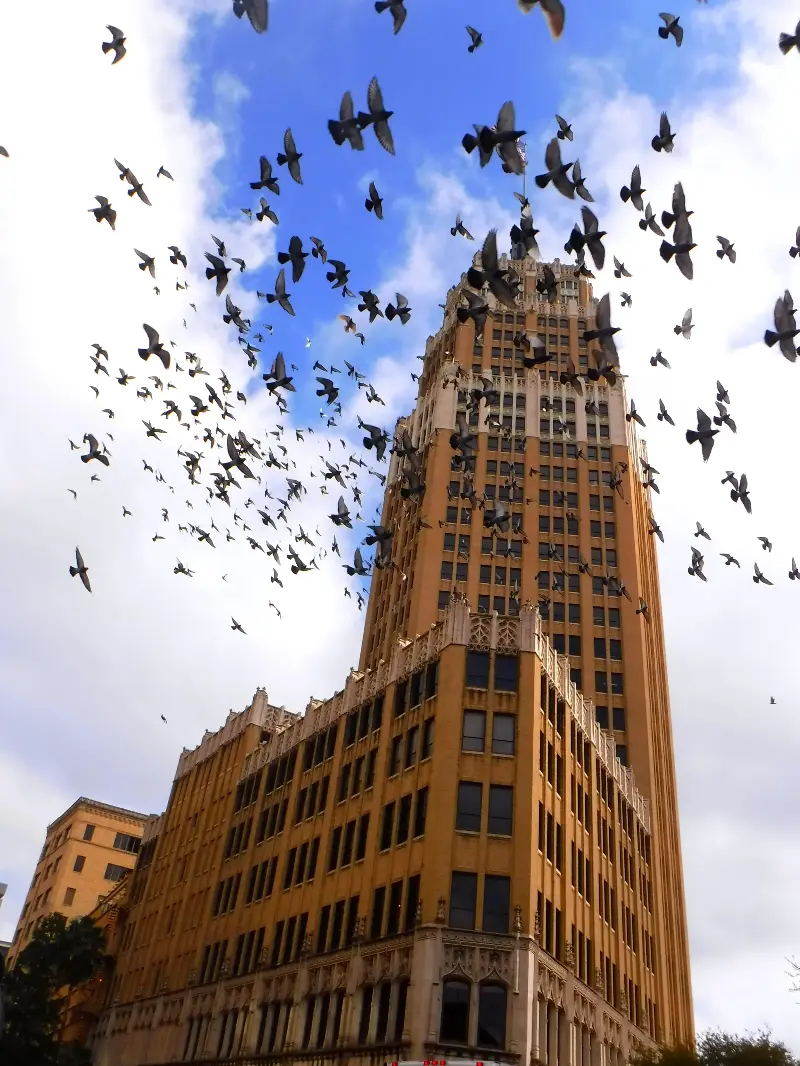
DALLAS — Every year, millions of birds travel across North Texas as they migrate during the spring and fall. But growing light pollution and glass windows can put them at risk, including in residential neighborhoods.
According to the U.S. Fish and Wildlife Service, more than 1 billion birds collide with glass in the U.S. each year, with a majority occurring at homes or low-rise buildings.
“A lot of people think when it comes to bird window collisions, it’s a problem with [just] skyscrapers, but it’s not,” said Mei Ling Liu, education specialist with the Texas Conservation Alliance.
Liu said homeowners can help protect migrating birds with a few simple changes.
Here’s what to know.
When is fall migration for birds in North Texas?
Peak spring migration for birds generally lasts from March until May, while fall migration runs September through November. Texas sees parts of major-migratory pathways, including the Central and Mississippi Flyways, which birds use to travel, according to Texas Parks and Wildlife Department.
“Birds fly without borders, so it’s hard to draw the line for the direction they are going,” Liu said.
About 444,000 birds crossed Dallas County the night of Oct. 9 into early Oct. 10, according to Cornell’s BirdCast map, which forecasts nocturnally migrating birds. Bird migration totals vary by day, but just over 45 million birds are estimated to have crossed through the region, as of Oct. 14.
Birds usually begin to migrate 30 to 45 minutes after sunset, with flight levels increasing two to three hours after that, according to Cornell’s BirdCast.
How do bright lights and glass buildings affect migrating birds?
Liu said birds are naturally drawn toward light, which can disorient them as they migrate through urban and suburban areas. While light is what draws birds in, Liu said colliding with the glass is often fatal or debilitating for birds.
According to a study from the Cornell Lab of Ornithology, Dallas is the third-most dangerous city for birds during spring and fall migration due to a combination of light pollution and geography risks, ranking just after Chicago and Houston.
Reflections on glass buildings or windows can be hard for birds to distinguish, Liu said. Oftentimes, birds will view vegetation in the reflection, thinking they’re flying into trees or green areas.
Additionally, Liu said some bird species that fly through Dallas-Fort Worth have more collisions than others and are known as “super colliders.”
“Some birds are more prone to collisions because they are very vocal, so when they're flying, they are kind of communicating with each other,” Liu said.
What can homeowners and businesses do to reduce bird collisions?
Liu said ways to reduce bird collisions largely include turning off non-essential lights and changing the reflectiveness of outdoor glass.
While bird collisions are often thought of as a downtown issue, Liu said the problem also affects residential areas and low-level buildings.
The first way to help protect birds is turning off whatever lights you can from 11 p.m. to 6 a.m. during peak migration season.
“A lot of times we do see decorative lights on the buildings, on the bridges as well,” Liu said. “We put lights everywhere. We want to see our skyline, but at the same time, do we ever consider that maybe at 11 p.m. or [midnight], we can turn off those lights to keep the sky darker?”
Switching outdoor lights from bright LEDs to warm amber lights can also help protect birds, as it’s less distracting, Liu said.
For homes and businesses, other ways to help keep birds safe is to turn off or dim the lobby, atrium and interior home lights, according to the Texas Conservation Alliance.
“If you drive in downtown Dallas at night, you can see there are so many windows,” Liu said. “It’s so bright, and we know there’s nobody there.”
Liu said if people can’t turn some lights off, make sure to draw the blinds and close curtains to help prevent light from leaking outside. Aiming outdoor lights down and shielding them, as well as installing motion sensors on outdoor lights can also help reduce light pollution.
Homeowners can also “treat” their windows, Liu said. According to the U.S. Fish and Wildlife Service, this can include adding transparent window films, window decals, external screens or UV reflective glass.
Liu said other wildlife like moths and bats also rely on dark skies, and light pollution is an issue that needs to be addressed beyond Dallas city limits.
“We cannot just rely on one city,” Liu said. “It should [be] across the board to have more cities recognize what they can do when it comes to outdoor lighting.”