


Leveraging sustainable poverty reduction
After the merger, Lam Dong became the largest province in the country in terms of area, 24,233 km2, with a population exceeding 3.8 million people. This new development space facilitates connections between the coastal region of Binh Thuan, with its significant potential for marine economy and services, and the mountainous border areas of Lam Vien and Dak Nong, home to many ethnic minorities. This is a major advantage but also presents numerous challenges in organizing social welfare, especially in areas far from urban centers with limited production resources.
In this context, credit capital from the Vietnam Bank for Social Policies (VBSP) is of particular importance and necessity. This is not only preferential capital, but also a tool to support people in developing production and business, creating jobs, increasing income, and gradually escaping poverty.

Thanks to the synchronized implementation of sustainable poverty reduction policies, along with the involvement of the entire political system, the consensus of organizations and businesses, and the contributions of the Vietnam Bank for Social Policies (VBSP), Lam Dong province currently has 9,700 poor households, accounting for 1.09% of the total number of households. The percentage of poor households belonging to ethnic minorities is 3.31%.
At the same time, the poverty rate decreased rapidly by 0.87% (equivalent to 0.33% of the total number of households) compared to the previous year. These figures demonstrate the remarkable progress in poverty reduction in the highland and coastal region of Lam Dong.
According to the report, the local poverty reduction achievements clearly reflect the effectiveness of the Vietnam Bank for Social Policies (VBSP) in focusing on mobilizing financial resources and effectively implementing the State's policy credit programs, especially prioritizing targeted and concentrated investments in Zone 3 - particularly difficult areas in mountainous border regions, coastal plains, and areas with large ethnic minority populations. Policy capital over the years, especially after one year following the merger and implementation of the two-tiered local government model, is not merely a financial matter, but a crucial "key" to sustainable poverty reduction and rural development.

As of mid-June 2026, the Vietnam Bank for Social Policies (VBSP) in Lam Dong province had implemented 21 policy credit programs with a total capital of approximately 20 trillion VND, an increase of 1,644 billion VND compared to the beginning of the year. Of this, entrusted capital from the local budget reached nearly 2,600 billion VND, accounting for 12.9% of the total capital, achieving 123.1% of the assigned plan. Accordingly, the total outstanding loan balance also reached a high level (19,935 billion VND), completing more than 90% of the assigned growth plan.
Immediately after the merger (July 1, 2025), the entire system of 21 transaction offices and 329 commune-level transaction points under the Vietnam Bank for Social Policies (VBSP) of Lam Dong province simultaneously launched operations, maintaining transaction sessions and stabilizing transaction schedules in 124 newly established communes, wards, and special zones. Disbursement of preferential loans was accelerated, alongside risk management and control of overdue debts, ensuring that funds reached the right recipients, were used for the right purposes, and were repaid according to regulations.



As a result, cumulative loan disbursements to date have exceeded VND 3,540 billion with 54,689 customers; debt collection accounts for 54% of loan disbursements, contributing to improved credit quality. Specifically, the amount of overdue debt is only VND 17,339 million, accounting for 0.09% of the total outstanding debt, with the Phu Quy branch of the Vietnam Bank for Social Policies and 11 communes having no overdue debt. The credit quality score of the Vietnam Bank for Social Policies in Lam Dong province for the first six months of 2026 reached 99.32 points, achieving a good rating.
Policy-based capital creates opportunities for people to improve their lives.
According to Ms. Nguyen Thi Ngoc Thu, Party Secretary and Director of the Vietnam Bank for Social Policies (VBSP) in Lam Dong province, the most significant advantage of the branches and affiliated units of the VBSP in the three provinces of Lam Dong, Dak Nong, and Binh Thuan is their shared 23-year history of development, coupled with the continuous guidance and support from higher-level banks and local Party committees and authorities. Leveraging this advantage, the merged VBSP in Lam Dong has continued to implement many specific and appropriate solutions, focusing on mobilizing resources and ensuring the timely and safe transfer of capital to communes, wards, and special zones, reaching the right poor households and policy beneficiaries.
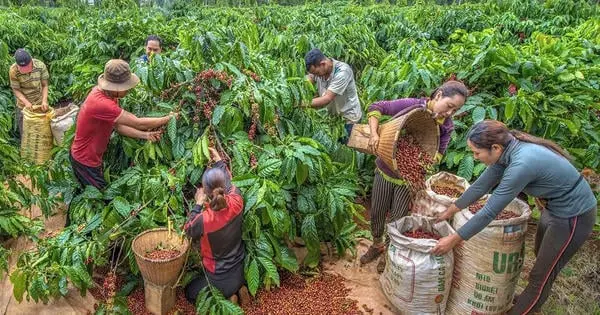
Preferential capital from the State, channeled through the Vietnam Bank for Social Policies, has helped people in the highlands and coastal areas of Lam Dong province to proactively engage in production and business, thereby improving their lives.

In Quang Khe commune, the impact of policy capital is evident in the proactive use of tens of billions of VND borrowed from the Social Policy Bank for production, vocational training, job chuyển đổi, intensive farming of fields and forests, aiming to reduce multidimensional poverty to below 1.7% and continuously improve the lives of the people.
For example, the family of Ms. Tran Thi Hoa, in Dak Lang village, Quang Khe commune, borrowed 50 million VND to convert their low-yield coffee plantation into mulberry cultivation and silkworm farming four years ago. Starting from a small model, thanks to applying techniques and diligent production, her family now has nearly 4 hectares of mulberry trees, ensuring a food source for 8 boxes of silkworms per batch. Ms. Hoa said: "For the past two years, the price of silkworm cocoons has been stable. After deducting expenses, each box of silkworms brings in nearly 10 million VND in income. This income has helped Ms. Hoa's family improve their living standards and become more prosperous."
Meanwhile, in Phuoc Hoi ward, Mr. Nguyen Vu Linh, from Mui Da neighborhood – a young, ambitious and proactive member of the Youth Union – used 100 million VND from the employment program to purchase fishing gear, stabilizing his family's finances and creating jobs and income for four local workers. “I am truly grateful to the staff of the Vietnam Bank for Social Policies for giving me the opportunity to change my life. The 100 million VND preferential loan, though not a huge amount, came to my family at the right time, supporting people to proactively engage in production,” Mr. Linh shared.
These poverty alleviation models show that, although not numerous, policy-based capital has truly acted as a leverage, a catalyst for changing the mindset and practices of poor households and ethnic minority families, helping them to steadily rise up and build new lives.
Maintain its role as a "lever"
What sets policy credit apart is its humanitarian objectives and its grassroots implementation, closely connected to the people. Poor households and ethnic minority families not only have convenient access to preferential capital but also receive guidance, inspection, and supervision through the system of commune, ward, village, and neighborhood authorities, entrusted socio-political organizations, and savings and loan groups. Therefore, the capital is not "left to fend for itself" but is always linked to the responsibility of using the capital, repaying the debt, and integrating with other programs.




In Lam Dong province, this need has become even more important after the merger. With a larger geographical area, a greater number of beneficiaries, and wider regional distances, a policy credit network that is deeply rooted in the community and closely connected to people in remote areas will face greater difficulties. Therefore, the Vietnam Bank for Social Policies (VBSP) focuses on close coordination with socio-political organizations, building a network of 6,404 Savings and Loan Groups to act as a "bridge" to cover the entire vast area with credit and deliver funds to the right recipients as quickly as possible.
Ms. Nguyen Thi Ngoc Thu, Director of the Vietnam Bank for Social Policies (VBSP) in Lam Dong province, affirmed: Entering a new phase, policy credit is determined to maintain its role as a "lever" in the sustainable poverty reduction effort. The effective implementation of Directive No. 39-CT/TW of the Party Central Committee, along with resolutions and decisions of the National Assembly and the Government, continues to be carried out extensively.
Simultaneously, efforts are focused on mobilizing resources and capital, emphasizing the improvement of credit quality while expanding policy coverage, and prioritizing the application of digital transformation in policy credit activities to bring modern banking transactions closer to poor households and ethnic minority families, helping them benefit from modern banking services in the new journey and development of the country.