



The US space agency NASA has discovered an exoplanet 146 light-years away that shares many characteristics with Earth and may harbor life.
This exoplanet, named HD 137010 b, is located approximately 146 light-years from Earth. According to NASA, the planet may lie on the outer edge of the "habitable zone" around its host star, meaning it could have liquid water on its surface and an atmosphere suitable for life.
However, life forms on this planet may have to adapt to a very cold environment. The host star of HD 137010 b has characteristics similar to the Sun but is cooler and less luminous. This could keep the planet's surface temperature from exceeding approximately -68°C. For comparison, the average surface temperature on Mars is around -65°C.
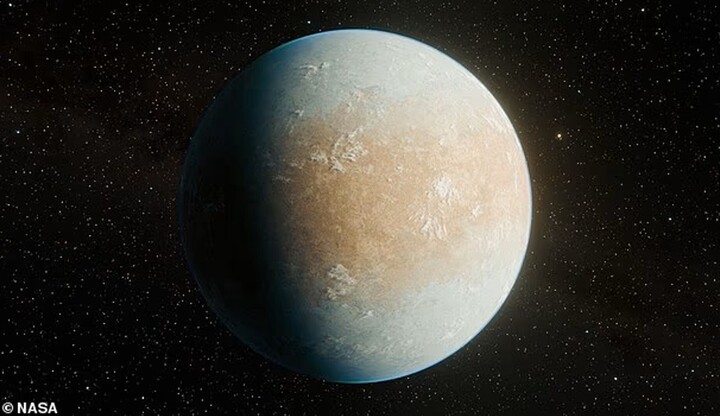
Planet HD 137010 b may have liquid water on its surface and an atmosphere suitable for life. (Image: NASA)
NASA scientists discovered this rocky exoplanet using data collected from the Kepler Space Telescope, after the planet "passed by" the surface of its host star.
Although a single flyby may not sound like much, it was enough for scientists to estimate the orbital period of HD 137010 b. Based on the time the planet's shadow takes to pass the Sun's surface, the research team estimated that the planet has an orbital period of 10 hours.
Computational models suggest the planet may be freezing. However, NASA believes there is still a possibility that HD 137010 b is a temperate or water-rich world if it possesses a carbon dioxide-rich atmosphere than Earth.
Based on atmospheric simulations, NASA estimates a 40% chance that the planet is in the "conservative" habitable zone, and a 51% chance of it being in the broader "optimistic" habitable zone. Scientists also warn that there is about a 50% chance the planet is completely outside the habitable zone.
To accurately determine the likelihood of habitability, the research team will continue monitoring. However, this is quite difficult because the planet's orbit is relatively similar to Earth's, resulting in less frequent transits compared to planets orbiting closer to their host stars.
NASA expects further observations to be made using the TESS satellite, the successor to Kepler, or the European Space Agency's CHEOPS satellite. If there is still insufficient data, further research may have to wait for the next generation of space telescopes.