


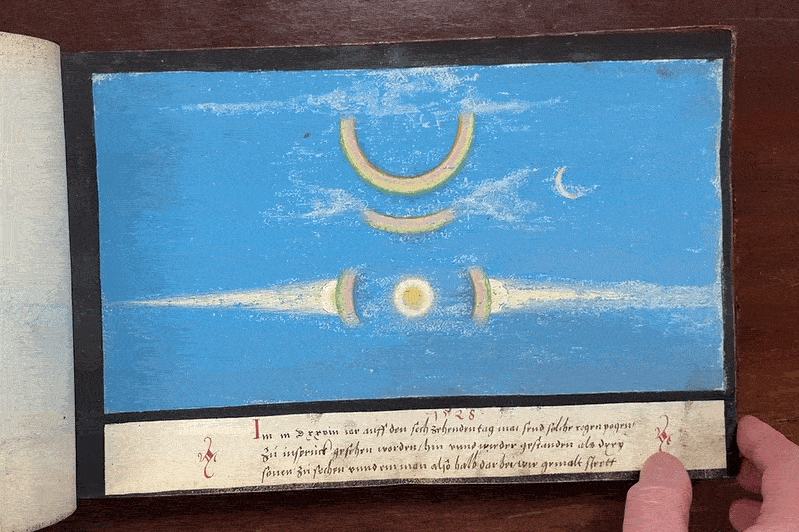
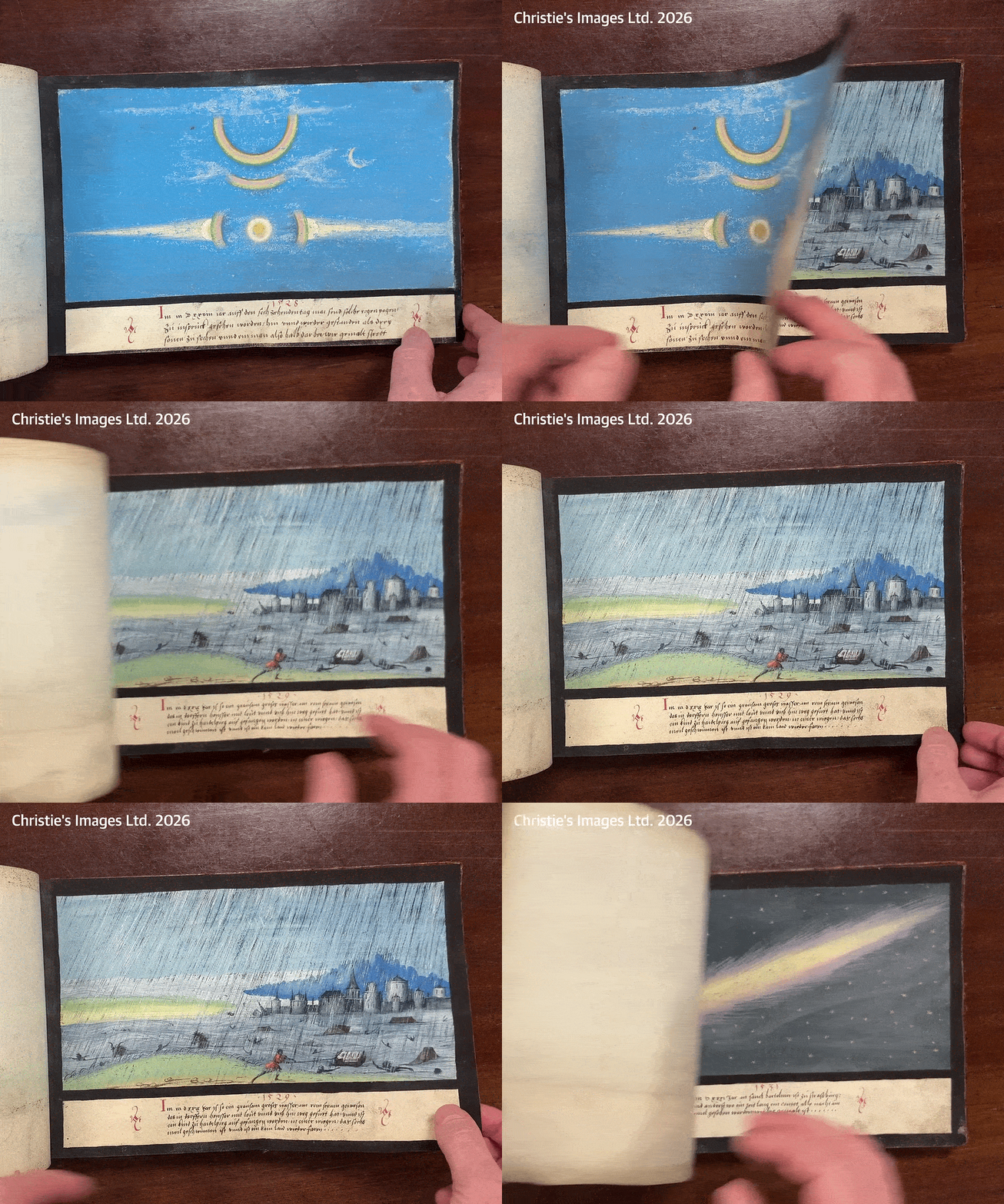
The Book of Miracles , an illustrated manuscript documenting strange natural phenomena that caused Europeans in the 16th century to fear the end of the world, will be auctioned at Christie's on December 10th. The work contains 167 paintings, including depictions of five suns appearing in the sky over Leipzig (Germany) in 1551, blood-red rain falling on Rome (Italy) in 1456, and a violent hailstorm in Dordrecht ( Netherlands ) in 1552, according to The Guardian . Photo: Christie's.

Created in the mid-16th century, the manuscript comprises 167 paintings depicting unusual natural phenomena and apocalyptic visions. At that time, earthquakes, floods, and extreme weather were often seen as omens from God. This is the only known copy, although its purpose remains unclear. The work is about to be auctioned by Christie's in London, England, with an estimated value of £700,000-£1 million ( US$923,000 - US$1.3 million ). The public can view the manuscript in person for six days before the auction. The painting depicts a flood in Frisia, now part of the Netherlands and Germany, in 1230. Photo: Christie's.

After being unknown for nearly 500 years, the manuscript was found in the library of a Baroque-style castle in southern Germany almost 20 years ago. In 2008, the work was sold along with the castle's furniture and furnishings for over £100,000, before becoming part of the private collection of Mickey Cartin, a contemporary art collector in Connecticut (USA). Above is a scene depicting the rain of blood falling on Rome in 1456. Photo: Christie's.

Eugenio Donadoni, Christie's expert on medieval and Renaissance manuscripts, said the Book of Miracles belongs to a line of books documenting rare and unusual phenomena in Germany. In the 16th century, these publications functioned as a form of mass media, reporting on noteworthy events and were used by Protestant theologians such as Martin Luther and Philip Melanchthon to spread the concept of the apocalypse. Notably, phenomena such as comets and natural disasters were recorded with eyewitness accounts, specific times and locations, contributing to a more evidence-based approach to observation and record-keeping. The illustration depicts "miraculous dragons" appearing in the sky over Bavaria (Germany) in 1533. Photo: Christie's.

Besides the five suns and red rain, the book also illustrates the locust plague that invaded Poland in 1527, the flood from the North Sea in 1230 in Frisia (now part of the Netherlands and Germany), as well as comets, solar eclipses, and lunar eclipses. The image of dragons flying across the Bavarian sky in 1533 is believed to depict the aurora borealis. Each painting has a German caption, clearly stating the time, location, and event. The artists based their depictions of phenomena that caused public concern on news, chronicles, and contemporary documents. According to Donadoni, some of the watercolor and gouache paintings have a surrealist style, reminiscent of Salvador Dalí, making them attractive to both classical and contemporary art collectors. The page depicts the locust plague that ravaged Poland in 1527. Photo: Christie's.

Today, many phenomena in the book have been scientifically explained. The image of five suns in Leipzig is believed to be a sunburst, occurring when light refracts through ice crystals in the atmosphere. The red rain in Rome may also originate from red dust, often originating from the Sahara Desert, mixing with rainwater. Donadoni likened reading the book in the 16th century to constantly scrolling through negative news on social media today (doomscrolling). According to him, the work reflects a period when superstitious thinking in the Middle Ages gradually shifted towards an observational and scientific approach to the world. The drawing depicts a terrible storm with hailstones that struck Dordrecht in the Netherlands in 1552. Photo: Taschen.

Till-Holger Borchert, director of the Suermondt-Ludwig Museum in Aachen, Germany, who studied the manuscript, said he was deeply impressed when he first saw the work. He noted that Christie's valuation of £1 million was quite conservative and the selling price could be higher. In 2013, a copy of the book was published, attracting the attention of researchers and the public. Since then, The Book of Miracles has become a quintessential work for those interested in the apocalypse. According to Borchert, the book's value lies not only in its historical significance but also in the anxieties about the future, natural disasters, and social instability that remain highly relevant. The drawing depicts a comet shining brightly in the night sky, its tail pointing towards Spain in 1506. Photo: Taschen.