



NASA releases Artemis II report: Orion heat shield stable, SLS rocket achieves perfect accuracy, bolstering confidence in goal of sending humans to the Moon by 2028.
The successful conclusion of the Artemis II mission not only marked a milestone in humanity's progress beyond its previous level, but also served as a rigorous real-world test for hardware systems.
Currently, NASA is conducting a detailed performance evaluation of the Orion spacecraft and SLS rocket to pave the way for the next crewed missions scheduled for 2027 and 2028.
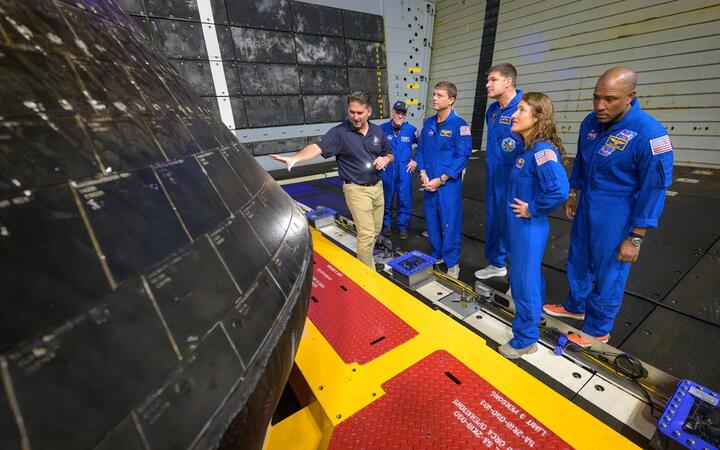
The Artemis II crew and NASA engineers inspect the Orion spacecraft's heat shield after a test flight. (Source: NASA)
The most noteworthy point in the initial report was the performance of the crew compartment's heat shield. Following the "burnt carbon layer loss" (surface peeling) incident during the Artemis I mission, engineers were particularly concerned about the Orion's heat resistance this time around.
NASA confirmed that the heat shield worked as expected, with no abnormalities detected. The re-entry into the atmosphere was extremely precise: the actual speed differed by only about 1.6 km/h from the calculation, allowing the Orion spacecraft to land in the target area less than 5 km from the intended point.
For the Space Launch System (SLS) rocket, data showed that the core stage with the RS-25 engines performed flawlessly. At the moment the main engines were shut off, the spacecraft reached a speed of over 29,000 km/h, placing the crew into orbit and their intended position with absolute precision.
Although the propulsion and protection systems were functioning well, the crew faced a significant challenge regarding their living conditions. Shortly after launch, a blockage occurred in the urinary drainage system.
Astronaut Christina Koch had to perform the repairs herself under guidance from ground control. NASA is now re-examining the entire hardware to ensure that future long-duration missions do not repeat the same mistake.

The Orion spacecraft's heat shield was photographed underwater by U.S. Navy divers after its landing, demonstrating its consistent performance during the Artemis II mission. (Source: NASA)
Besides technical factors, the health of the crew is also an important research topic. After just 10 days in a weightless environment, the human body begins to experience changes in its navigational abilities.
Astronaut Koch shared that returning to Earth was a difficult adjustment process. In the space environment, the vestibular system (the balance-maintaining organ in the inner ear) stopped functioning normally, causing the brain to gradually ignore signals from this organ.
Upon returning to a gravity environment, astronauts must rely entirely on their vision to maintain balance and often have difficulty moving if their eyes are closed.
The promising findings from Artemis II are bolstering NASA's confidence in achieving its goal of sending humans on the surface of the Moon by 2028.