



Previously unpublished archival documents reveal that these works were actually stored in a room with multiple locks, which could only be opened with the consent of several people involved.
An Italian researcher has just revealed that the Renaissance painter Michelangelo ordered his apprentices to hide many of his artworks in a "secret room" to protect them for future generations.
According to the renowned art historian Giorgio Vasari, the Italian genius burned a large number of his own drawings and sketches before his death in Rome in 1564.
However, in an interview with the press on March 4th, researcher Valentina Salerno stated that previously unpublished archival documents reveal that these works were actually stored in a room with multiple locks and could only be opened with the consent of several people involved.
After more than a decade of research, Salerno traced the documents through archives in the Vatican (Italy) and many cities in Europe, including the French capital, Paris.
She described this as a "meticulous plan" that Michelangelo had undertaken, with the aim of protecting his artwork so that his poor, non-aristocratic descendants could continue to study and pass on the art to future generations.
Those involved in this plan subsequently founded the San Luca Academy of Arts in the 16th century, an institution that still exists today.
Salerno believes that this secret chamber, where Michelangelo's works are hidden, may be located within the Church of Saint Peter in the Chains in the heart of Rome.
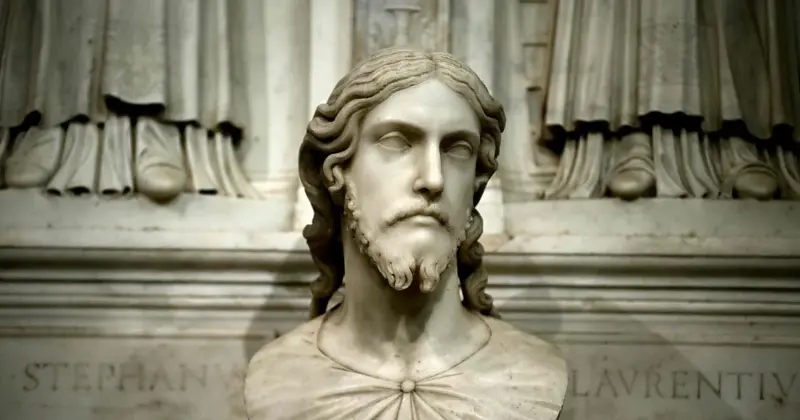
During her research, Salerno also discovered a document relating to a bust at the Sant'Agnese Church, also in Rome. This bust is believed to be by an unknown artist.
According to researcher Salerno, historical documents show that the white marble statue depicting Christ the Redeemer was believed to be the work of Michelangelo for centuries. However, later, in the 1980s, Italian cultural authorities determined it to be the work of an unknown sculptor.
Nevertheless, researcher Salerno asserts that this bust is indeed a genuine work by the genius Michelangelo, not only based on documents but also because its form bears a striking resemblance to Tommaso dei Cavalieri, a young nobleman Michelangelo was once infatuated with.
Salerno's research has not yet been peer-reviewed, but she is a member of the Vatican committee organizing the 550th anniversary of Michelangelo's birth.
Michelangelo Buonarroti (1475-1564) was one of the most famous sculptors, painters, architects, and poets of the Renaissance. He was also one of the most influential Western artists of all time, famous for several masterpieces including the statue of David, The Pieta, and the great paintings in the Sistine Chapel, Vatican City.