


- 1. Differentiating between physiological and pathological hair loss.
- 2. Common causes of pathological hair loss
- 3. Self-checking signs
- 4. Proper hair care for mild hair loss.
- 5. Adjust your diet.
In fact, hair loss is divided into two types: normal physiological hair loss and pathological hair loss that requires attention. Healthy adults losing about 50 to 100 strands of hair per day is a natural metabolic process of the hair follicles and is not a cause for excessive worry.
If you lose more than 100 strands of hair each time you wash it, or an average of more than 150 strands per day for several consecutive days, along with signs such as a widening hair parting, and hair becoming thinner and weaker, you should be wary as this could be pathological hair loss.
1. Differentiating between physiological and pathological hair loss.
Each hair follicle on the scalp has a fixed growth cycle:
- Growth phase: Lasts from 2 to 6 years, during which hair grows strong and thick.
- The regression phase: Lasts 2 to 3 weeks, during which the hair follicles gradually shrink.
- Resting phase: Lasts 2 to 3 months. After this phase, the old hair will fall out, making way for new hair to grow.
Pathological hair loss occurs when the hair follicle's growth cycle is disrupted by external factors, or when the hair follicle itself is damaged. There are many common causes of this condition.
2. Common causes of pathological hair loss
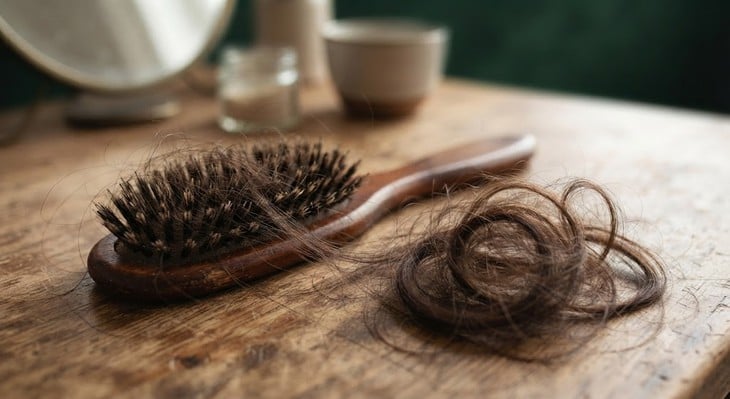
Hair loss is a fairly common problem, and in most cases, it can be improved through lifestyle adjustments and proper care. (Illustrative image by AI)
Androgenic alopecia: This is the most common type of pathological hair loss, related to genetic factors and the body's sensitivity to androgen hormones. Hair follicles gradually shrink, and the hair that grows back becomes thinner and shorter, eventually leading to a wider hairline and thinning on the crown. In men, it is often manifested by a receding M-shaped hairline, while in women it is mainly manifested by a widening hairline.
Seborrheic dermatitis: This is a condition where the yeast Malassezia on the scalp grows excessively, causing inflammation, making the scalp oily and itchy, and also clogging hair follicles, leading to increased hair loss, often accompanied by many grayish-white dandruff flakes.
Endocrine disorders: Such as a sudden drop in hormones after childbirth, hormonal fluctuations during perimenopause, or thyroid dysfunction, can disrupt the hair follicle growth cycle, causing diffuse hair loss. This condition usually improves after hormone levels stabilize, but severe cases still require medical intervention.
Nutritional deficiencies are a significant cause. When ferritin levels, an indicator of the body's iron reserves, fall below 30 micrograms/liter, it affects the supply of oxygen and nutrients to the hair. A lack of protein in the diet also deprives hair of the building blocks for growth, making it dry, brittle, and prone to breakage, all of which can lead to increased hair loss.
Prolonged stress or frequent late nights: These can cause hair follicles to enter the resting phase prematurely, leading to stress-induced hair loss, which usually becomes apparent about 2 to 3 months after the stressful event.
3. Self-checking signs
You can assess the condition of your hair yourself through the following four signs; if you have two or more of these signs, you should see a doctor as soon as possible:
- The hair parting is more than 1 cm wider than it was a year ago.
- The hair on the crown or hairline thins noticeably, making the scalp visible.
- Each time I wash or brush my hair, more than 100 strands fall out, which is equivalent to about a handful for an adult.
- My hair has become increasingly thin and soft, like downy hair, compared to before.
4. Proper hair care for mild hair loss.
For mild hair loss, averaging 50 to 100 strands per day, without noticeable widening of the hairline, adjustments can begin with daily lifestyle habits:
You should wash your hair with water below 38 degrees Celsius , because water that is too hot can damage the scalp's protective barrier, irritate hair follicles, and worsen hair loss.
Use your fingertips to gently massage your scalp while washing your hair instead of scratching with your fingernails to avoid causing abrasions. Massage also helps promote blood circulation in the scalp, supporting hair follicles in absorbing nutrients better.
Washing your hair about 2 to 3 times a week is reasonable; washing too often disrupts the natural oil balance of the scalp, while washing too infrequently causes oil and dirt to accumulate, clogging hair follicles.
5. Adjust your diet.
Consume iron-rich foods such as lean beef, pork liver, or dark leafy greens and wood ear mushrooms about once or twice a week to prevent hair loss due to iron deficiency.
Protein-rich foods such as eggs, milk, fish, and soy products should be included regularly in your daily diet to provide sufficient building blocks for hair growth.
Vitamin D supplementation : Eat more dark leafy greens and salmon to help supplement vitamin D, which helps maintain healthy hair follicles. You can also get 15 to 20 minutes of sun exposure each day, avoiding the harsh midday sun.
If you have adjusted your lifestyle and home care for about 1 to 2 months and your hair loss has not improved, or if you have noticeable signs of a wide hairline or thinning hair on the crown, you should see a dermatologist.
Hair loss is a fairly common problem, and in most cases, it can be improved through lifestyle adjustments and proper care. However, one should not ignore the signs of underlying medical conditions. Regularly monitoring the amount of hair loss and seeking early medical attention when unusual symptoms appear will help in timely intervention before hair loss becomes irreversible.