




Czinger has introduced the 21C Spyder, an open-top variant of its 21C hypercar that debuts a new integrated braking system and a redesigned cockpit structure. Founder and CEO Lukas Czinger described the model as building on the original 21C’s approach of engineering vehicle systems from the ground up rather than adapting existing components.

Only 30 units will be built, with pricing starting at $2.75 million. Each car will be assembled at Area 21, Czinger’s production facility in Los Angeles, and customized to individual owner specifications.
Central to the Spyder’s introduction is BrakeNode, which Czinger calls the first fully integrated, additively manufactured, and topology-optimized brake assembly to reach production. Rather than mounting the caliper separately from the suspension upright and routing hydraulic lines externally, BrakeNode combines the caliper, upright, and hydraulic fluid passages into a single 3D-printed component made from the company’s proprietary Z301 aluminum alloy.

Compared to conventional brake structures, Czinger says the system reduces unsprung mass and increases stiffness by up to 30% each, cutting total unsprung mass by 6 lbs (2.7 kg) across the vehicle. Stopping distance is reduced by up to 15%. The front calipers use titanium pistons, which are said to keep hydraulic fluid 15% cooler than those in stainless steel calipers, while the rear calipers use aluminum pistons. Brake pads clamp onto carbon-ceramic rotors measuring 16.1 inches in diameter at the front and 15.3 inches at the rear. Czinger states the system has been pressure-tested at up to 500 bars, eight times the 21C’s normal operating pressure.

The company adds that BrakeNode also simplifies servicing, since pads can be accessed from the top of the structure and rotors removed by tilting them out from the side, without disconnecting the caliper. It comes standard on the Spyder and is available as an upgrade for existing 21C HDF and VMax owners.
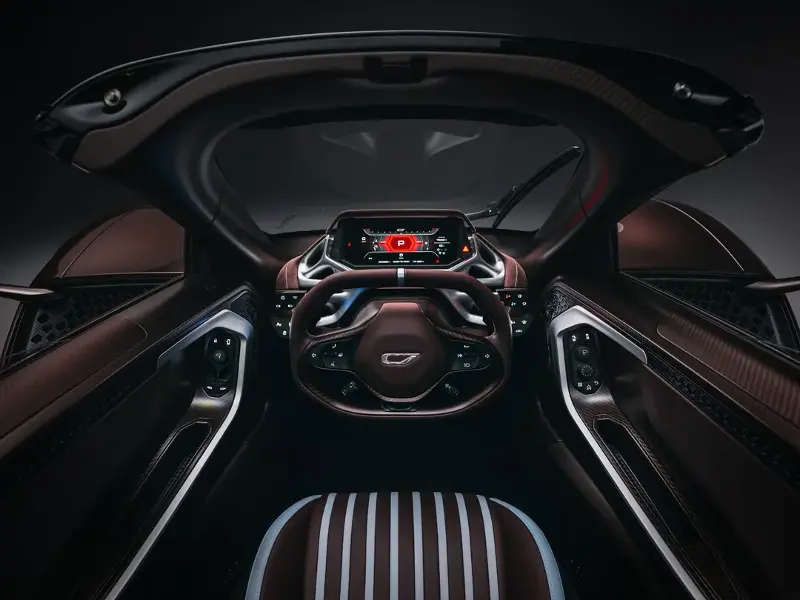
The dashboard has been replaced by what Czinger calls NeuralNode, a single structure that houses the instrument panel, HVAC ducting, and controls. Two arms extending from the steering column carry lighting, drive mode, and climate controls. Door-mounted mirror, window, and infotainment controls are finished in machined metal, and the cabin adds a redesigned steering wheel with a fully upholstered rim, along with new phone and key mounts and a cupholder.
Audio comes from an 8-speaker, 650-watt Morel system with two subwoofers in the lower cabin and additional speakers in each door. The driver display doubles as the infotainment screen and supports wireless Apple CarPlay.
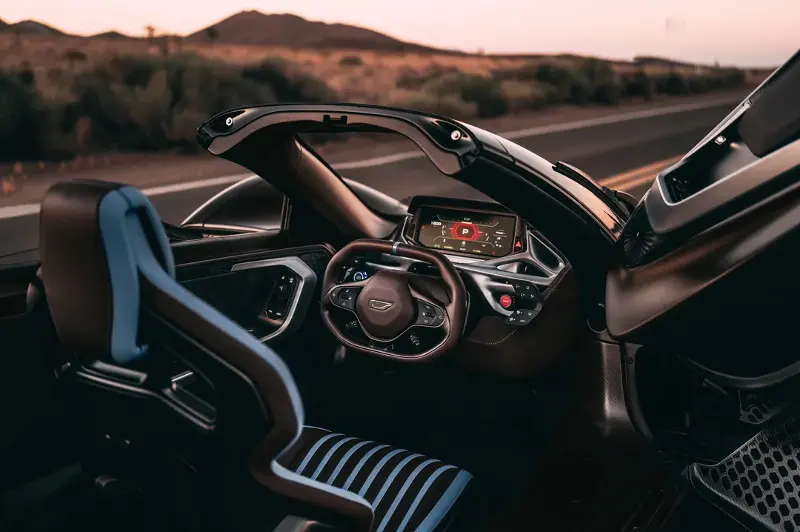
A removable carbon fiber hardtop, weighing 22 lbs, detaches via two cabin-mounted latches and stores on a dedicated roof mount included with the car. A stowable soft top is also provided for use in unexpected weather.
The Spyder retains the 21C’s central, inline two-seat layout, with the driver positioned ahead of the passenger in a configuration Czinger compares to a fighter jet cockpit. That packaging shaped the engine bay, leaving room aft of the cabin for a compact 2.88-liter twin-turbo V8 developed in-house.
The engine revs to 11,000 rpm and produces 750 hp on 91-octane fuel, which Czinger describes as the most power-dense homologated V8 currently in production at 260 hp per liter. It weighs 104 kg, roughly 45 kg less than the average hypercar engine, thanks to additively manufactured exhaust and intake manifolds, a catalyst assembly, and thermal management components.

Power is routed through a seven-speed single-clutch transmission developed with Xtrac, using a 48-volt electrically actuated twin-barrel shift system controlled by three motors for sub-100-millisecond gear changes. Two electric motors drive the front wheels independently, while a third motor connected to the crankshaft primarily charges the car’s two 2.1-kWh, 800-volt batteries and helps offset turbo lag. The combined output of the hybrid system reaches 1,250 hp and 936 Nm of torque.
Czinger lists a 0-100 km/h time of 1.9 seconds, a quarter-mile time of 8.7 seconds, and a top speed of 330 km/h.
With the roof removed, the Spyder generates 1481 kg of downforce at 241 km/h, which Czinger claims is the most of any open-top road car; with the hardtop installed, that figure rises to 3,307 lbs, matching the 21C HDF. The car uses a front splitter, dive planes, full-length side splitters, a rear diffuser, and a dual-element 76-inch rear wing with three-way adjustability.
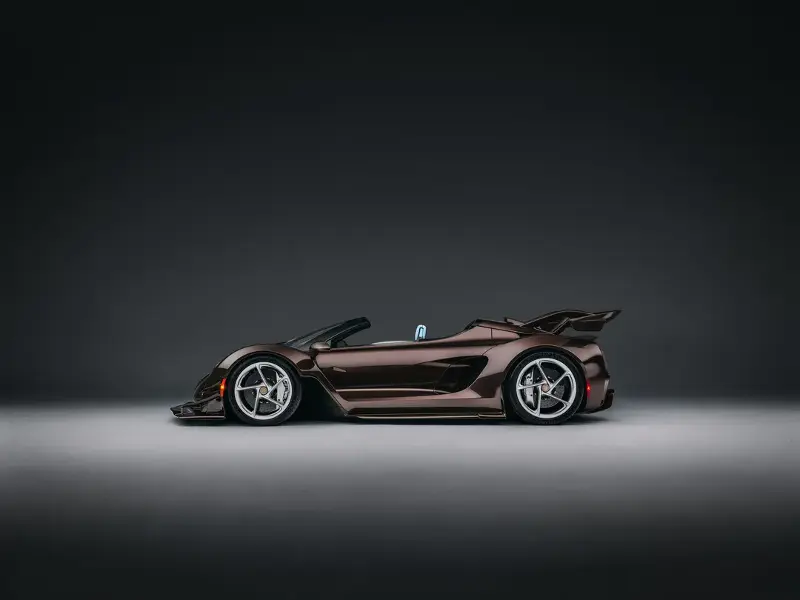
Roughly 23% of the Spyder is additively manufactured, using processes from sister company Divergent Technologies. The carbon fiber monocoque tub weighs 276 lbs and, unlike the coupe, includes added carbon fiber layering in the A-pillars to account for the removable roof. Total dry weight is listed at 1619 kg, which is just marginally heavier than the 21C HDF.

Suspension is a dual A-arm pushrod setup with inboard springs and electronically adjustable dampers, with control arms said to be 20% lighter than a conventional design. In its firmest Track+ setting, damper stiffness increases by 50% alongside a 25mm drop in ride height.
Czinger says the 21C Spyder meets Federal Motor Vehicle Safety Standards and California CARB emissions requirements, and underwent more than 35 crash tests during development, including additional roof crush testing specific to the Spyder body style.
The car offers four drive modes. Street mode runs on front-motor electric power below 60 mph before engaging the rear axle, capping output at 1,140 hp. Sport mode enables full all-wheel-drive output at the same power level with road-compliant suspension tuning. Track mode unlocks the full 1,250 hp and holds gears to redline in manual-style shifting from second gear up. Track+ adds the lowered ride height and stiffened dampers and is intended for circuit use only.
The post Czinger introduces the 21C Spyder during Monterey Car Week appeared first on YugaAuto: Automotive News & Reviews in the Philippines.